Spain housing shortage: figures and financing
Spain’s housing shortage is the gap between the households being formed and the homes being built. According to the Observatory of Alternative Financing with Mortgage Collateral in Spain, 665,000 homes were missing between 2008 and 2025, and about 238,000 homes a year would be needed until 2039. Here are the figures, why bank lending alone cannot close the gap and what it means for a private investor.
This text is educational. It is not investment advice.
Spain housing shortage: the Observatory’s figures
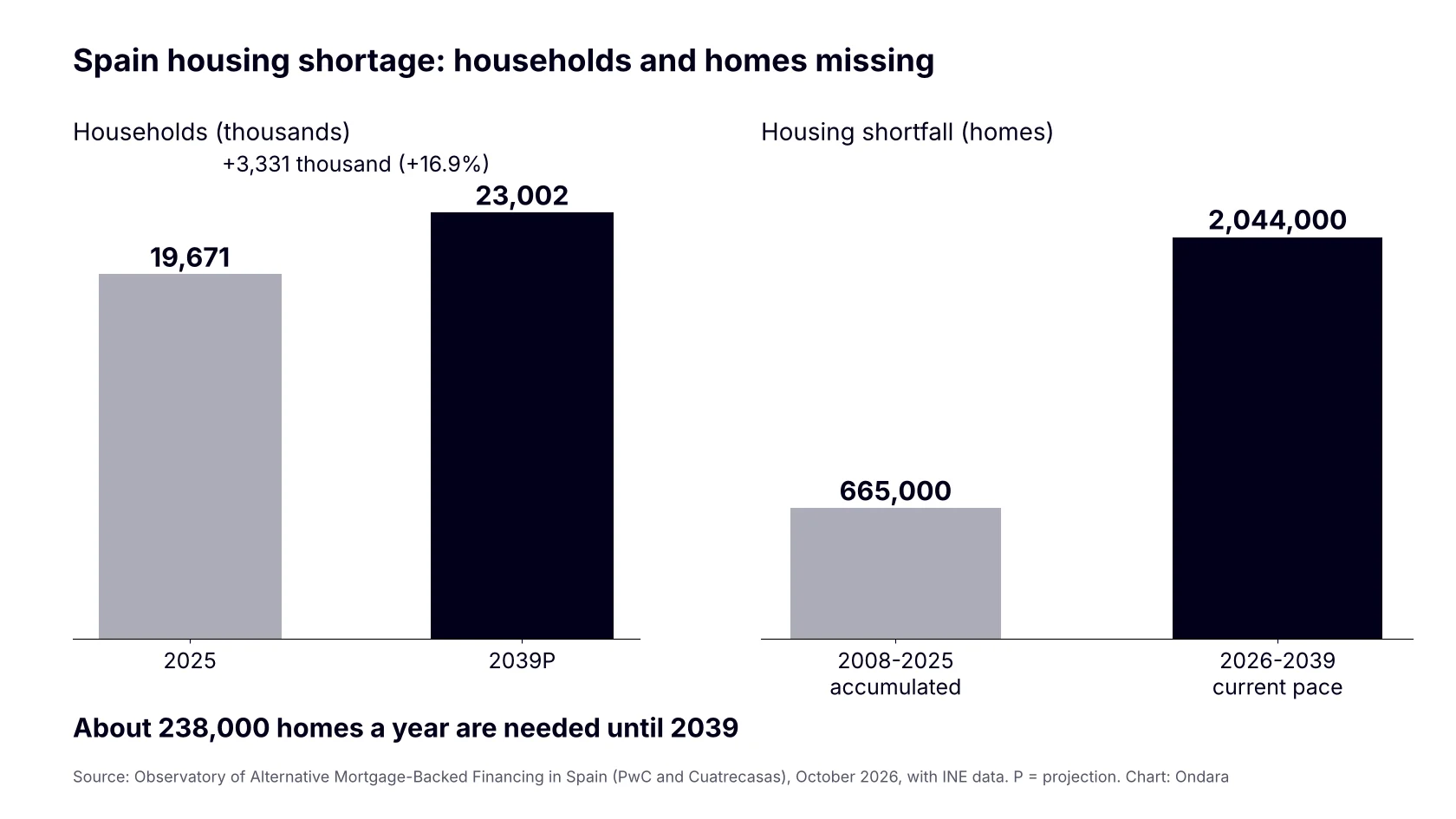
The Observatory of Alternative Financing with Mortgage Collateral in Spain, with market analysis by PwC and legal framework by Cuatrecasas (October 2026) starts from the household projections of the INE, Spain’s statistics office. The main figures are:
| Indicator | Figure |
|---|---|
| Households in 2025 | 19,671 thousand |
| Projected households in 2039 | 23,002 thousand |
| Additional households | 3,331 thousand (+16.9%) |
| Homes needed per year | About 238,000 |
| Accumulated shortfall 2008-2025 | 665,000 homes |
| Additional shortfall 2026-2039 at the current pace | 2,044,000 homes |
The annual figure comes from dividing the 3,331 thousand new households by the 14 years from 2026 to 2039. If the pace of building does not rise, the additional shortfall would be 2,044,000 homes, according to the report. These are projections: they depend on demographics and on actual construction.
Why the homes that are needed are not being built
The Observatory points to four supply constraints:
- Scarce serviced land: little urbanised land is ready to build on.
- Long planning timelines: zoning and permits delay the start of works.
- Construction costs: up 48.3% between 2018 and 2025.
- Shortage of skilled labour: a bottleneck for building more.
Financing adds to the problem. Many projects are at stages that banks do not fund. As we saw in alternative mortgage-backed lending in Spain: 2026 figures, bank lending to real estate and construction fell by 80% between 2008 and 2025, according to the Banco de España (Spain’s central bank).
Trends: what is happening worldwide and in Spain
- Spain, 23 September 2026: Soledad Núñez, Deputy Governor of the Banco de España, put the accumulated shortfall since 2021 at about 755,000 homes and said it could grow by another 300,000 between 2026 and 2028, as reported by Brainsre. She also said mortgage lending standards remain prudent and that she does not see, for now, a 2008-style scenario.
- Spain, 20 March 2026: the real estate sector report by CaixaBank Research (in Spanish) expects the shortfall to exceed 900,000 homes in 2029, concentrated in large cities and tourist areas.
- Worldwide, European housing investment platform: the European Commission is preparing for 2026 a pan-European investment platform for affordable housing to bring together public authorities and private investors. It estimates an investment gap of about EUR 150 billion a year. Its real scope remains to be seen.
The estimates differ because they measure different things:
| Source | Period | Estimate |
|---|---|---|
| Observatory (INE data) | 2008-2025 | 665,000 homes |
| Banco de España | Since 2021 | About 755,000 homes |
| CaixaBank Research | Forecast to 2029 | Over 900,000 homes |
What it means for an investor in Spain: the need for housing is structural, but the figures vary with the method. What matters is not the exact number but that new supply has to be financed with more capital than banks have provided in recent years. For the market backdrop, read Spain home sales in 2026.
Housing shortage and financing: the role of private capital
The Observatory’s reading is simple: the volume of capital needed is not in the banking system, and many projects are at stages banks do not fund. That is where alternative financing with mortgage collateral comes in: bridge loans, developer loans and deals where banks arrive later.
That does not make every project a good investment. A shortage of homes does not guarantee that a given developer will finish the works, sell at a good price or repay the loan. Each transaction has to be analysed. For the products themselves, see alternative finance for residential development in Spain and financing modular construction in Spain.
How Ondara works in this context
Ondara Group is an alternative investment manager based in Barcelona, active since 2018. We structure private debt transactions backed by real estate, analyse each one individually and work with real assets as collateral. Investors deal directly with the management team and the minimum investment is EUR 25,000. You can meet the team on the who we are page.
Risks to consider
All investments carry risk, including partial or total loss of capital. In housing finance, in addition:
- Execution risk: permits, costs and labour can delay or raise the cost of works.
- Price and sales risk: if prices or demand fall, the project’s exit becomes harder.
- Borrower risk: the developer may fail to repay the loan on time.
- Regulatory risk: changes to land, rental or housing rules can affect a project’s returns.
- Illiquidity and term: capital is tied up until repayment.
Real estate collateral mitigates risk but does not eliminate it.
Frequently asked questions
What is Spain’s housing shortage?
It depends on the source: 665,000 homes between 2008 and 2025 according to the Observatory, about 755,000 since 2021 according to the Banco de España. The periods and methods differ.
How many homes are needed each year?
About 238,000 until 2039, according to the Observatory using INE household projections.
Why is more not being built?
Because of scarce serviced land, planning timelines, rising costs and a shortage of skilled labour.
How does this relate to alternative financing?
Many projects are at stages banks do not fund, and alternative financing with mortgage collateral covers part of that gap.
Is a housing shortage enough to make an investment good?
No. Each transaction has its own risk and should be analysed with a professional before investing.
In summary
- The Observatory puts the accumulated 2008-2025 shortfall at 665,000 homes and the need at about 238,000 a year until 2039.
- Other sources give different figures because they measure different periods and concepts.
- Supply faces constraints on land, timelines, costs and labour, and needs more financing than banks provide.
- The need for housing does not remove the risk of each transaction.
If you would like to know how we invest, register as an investor and we will explain how it works. The minimum investment is EUR 25,000.
This article is for information purposes only and does not constitute an investment recommendation or financial advice. All investments carry risks, including the possible loss of the capital invested, and past or target returns do not guarantee future returns. Analyse each opportunity with a professional before investing.