Modular construction financing in Spain: how it works
Financing modular construction in Spain has a collateral problem: a module built in a factory, away from the plot, is not real property for mortgage purposes until it is assembled. That is why banks arrive late and private capital comes in earlier. Spain delivered 4,272 industrialised homes in 2025 (forecast), 4.6% of new-build housing, according to the Observatorio. Here is how the segment is financed and what a private investor should look at.
This text is for general information. It is not investment advice.
What industrialised construction is and why it matters
Industrialised (or modular) construction builds much of a home in a factory, as modules, panels or structural frames, and assembles it on site afterwards. It works more like a production line than a traditional building site.
According to the Observatorio de Financiación Alternativa con Colateral Hipotecario en España, with PwC market analysis and Cuatrecasas legal framework (October 2026), the advantages over traditional building are:
| Aspect | Effect of industrialising |
|---|---|
| On-site labour | Up to 30% less |
| Productivity | Up to 30% higher |
| Build time | 35% to 50% shorter |
| CO2 emissions | 60% to 75% lower |
Traditional building has its own problems. Construction employment fell from 2.5 million in 2008 to 1.5 million in 2024. Costs rose 48.3% between 2018 and 2025. And, according to the same report, 90% of projects are not finished on time.
The numbers: how many industrialised homes are delivered
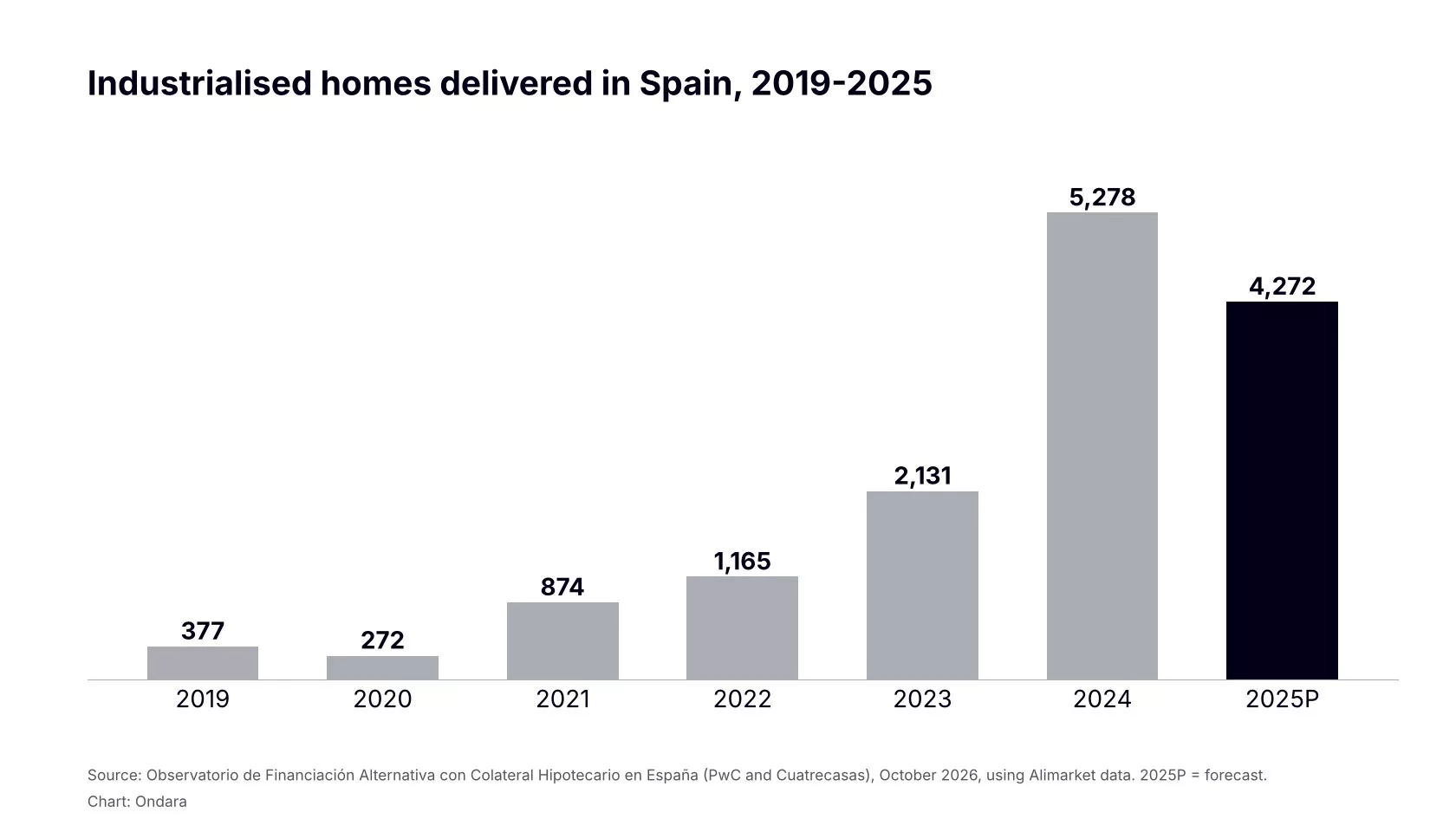
The segment is still small, but it has grown sharply since 2019. In 2025 the forecast is 4,272 homes, or 4.6% of new builds. Sweden is around 45%.
| Year | Industrialised homes delivered |
|---|---|
| 2019 | 377 |
| 2020 | 272 |
| 2021 | 874 |
| 2022 | 1,165 |
| 2023 | 2,131 |
| 2024 | 5,278 |
| 2025F | 4,272 |
The series is not smooth. Deliveries rose 148% between 2023 and 2024, but the 2025 forecast is 19% below 2024. It is a young segment and the data are still uneven.
Trends: what is happening worldwide and in Spain
- Worldwide, 15 October 2026: an international law firm announced the closing of a financing platform of about GBP 1.9 billion for a modular rental provider in northern Europe, structured like infrastructure debt with an investment-grade rating. It closed on 7 October. See Simpson Thacher. It shows institutional capital is looking at modular, although in northern Europe and with a rental model different from Spain’s.
- Spain, 8 May 2026: the Ministry of Housing opened a preliminary public consultation on the rules for grants to promote industrialised construction. The grants will be called later, so amounts and deadlines are not yet certain. The Observatorio notes that the housing industrialisation PERTE (a public recovery programme) has EUR 1.3 billion and targets 20,000 industrialised homes a year by 2035.
- Worldwide, 13 October 2026: the IMF’s Global Financial Stability Report warns of leverage and liquidity risks in private credit. For investors, a reminder that a new sector calls for more discipline in selecting deals.
What it means for an investor in Spain: there is demand for capital in a segment that banks find hard to finance and that the public sector wants to promote. But it is new, with little track record and collateral that still has to be designed.
The legal problem: what do you mortgage if the module is in the factory?
According to the Cuatrecasas legal analysis in the Observatorio (Carlos Lasarte), article 334.1 of the Spanish Civil Code treats only constructions attached to the ground as real property. What is made off site is therefore not classic mortgage collateral until it is assembled.
The report proposes splitting the financing into two tranches:
| Tranche | What it finances | Collateral |
|---|---|---|
| Industrial | Manufacturing the modules | Non-possessory pledge or movable-property mortgage |
| Developer | The project once assembled on the plot | Real estate mortgage, refinancing the industrial tranche on assembly |
The report gives a key role to the Project Monitor (an independent supervisor who certifies progress) and to insurers.
How it fits alternative financing
It makes sense for private capital to come in before banks: the asset (the module) is not yet real property, the project has no track record and timing depends on both factory and site. The underlying market is large: according to Euroconstruct, reported by the Observatorio, residential construction is worth EUR 62.8 billion, with a compound annual growth rate of 4%.
How Ondara works in this context
Ondara Group is an alternative investment manager based in Barcelona, active since 2018. We structure private debt transactions backed by real estate, analyse each one individually and work with real assets as collateral. Investors deal directly with the management team and the minimum investment is EUR 25,000. You can meet the team on the who we are page.
Risks to consider
All investment carries risk, including partial or total loss of capital. In industrialised construction, also:
- Incomplete collateral: until the module is assembled, the security is not a classic real estate mortgage.
- Manufacturer risk: a breakdown, delay or default at the plant halts delivery.
- Assembly and licence risk: moving from factory to site depends on permits and groundworks.
- Little track record: the segment is young and delivery data are uneven.
- Illiquidity and term: capital is tied up until repayment.
Real estate collateral mitigates risk but does not remove it.
Frequently asked questions
What is industrialised construction?
Building part of a home in a factory, as modules or panels, and assembling it on the plot afterwards.
How many industrialised homes are delivered in Spain?
The 2025 forecast is 4,272, or 4.6% of new builds, according to the Observatorio using Alimarket data.
Why is it hard to finance?
Because what is made off site is not real property under article 334.1 of the Civil Code and does not work as classic mortgage collateral.
How is the collateral problem solved?
The report proposes an industrial tranche, with a non-possessory pledge or movable-property mortgage, and a developer tranche with a real estate mortgage that refinances it on assembly.
Can a private individual invest in these projects?
Yes, with risk of capital loss and illiquidity. Each project should be reviewed with a professional before investing.
In summary
- Industrialised construction cuts build time and labour, but is still 4.6% of new builds.
- The financing difficulty is legal: a module in a factory is not real property.
- The Observatorio proposes two tranches with different collateral and independent monitoring.
- It is a new segment: more financing opportunity and more uncertainty.
If you would like to know how we invest, register as an investor and we will explain how it works. The minimum investment is EUR 25,000.
This article is for information purposes only and does not constitute an investment recommendation or financial advice. All investments carry risks, including the possible loss of the capital invested, and past or target returns do not guarantee future returns. Analyse each opportunity with a professional before investing.