Alternative lending in Spain: key challenges in 2026
The main challenges for alternative lending in Spain are strong bank competition with large developers, a cultural aversion to borrowing and several legal and market uncertainties. As a result, alternative financing accounts for about 20% of the market in Spain, against 75% in the United States and 50% in the United Kingdom.
This text is educational. It is not investment advice.
How much alternative lending weighs in Spain
The Observatorio de Financiación Alternativa con Colateral Hipotecario en España (Observatory of Alternative Financing Backed by Mortgage Collateral in Spain), with market analysis by PwC and legal framework by Cuatrecasas (October 2026), estimates that alternative volume backed by mortgage collateral rose from EUR 1,473 million in 2023 to EUR 2,583 million in 2025, with EUR 3,891 million forecast for 2026. It is growing, but from a small base.
| Market | Share of alternative financing |
|---|---|
| United States | 75% |
| United Kingdom | 50% |
| France and Germany | 40% |
| Spain | 20% |
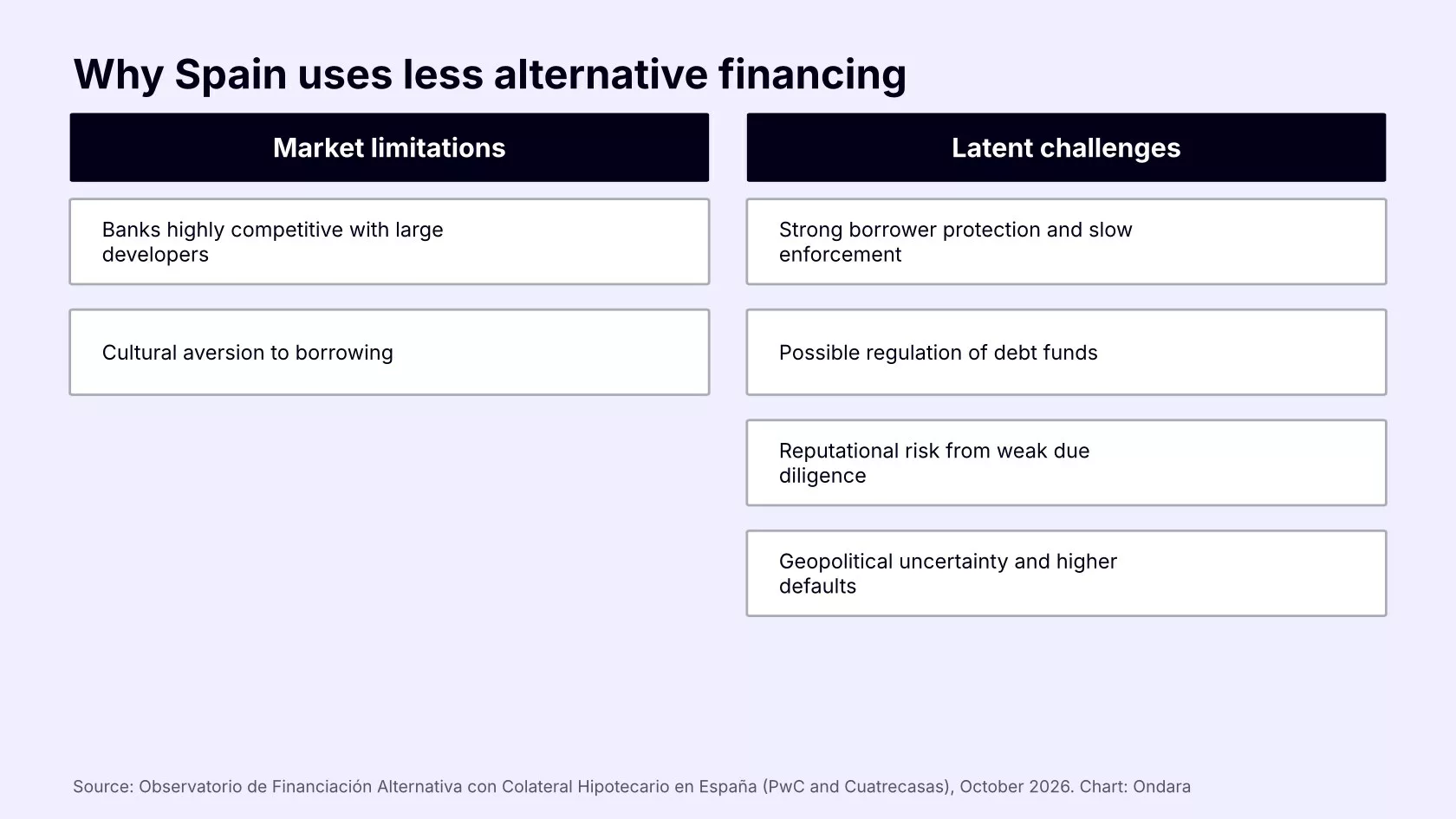
The gap is not explained by a lack of demand. The report identifies two specific limitations and several latent challenges. We look at each in turn. For the market in figures, see our analysis of alternative mortgage lending in Spain.
First limitation: banks are very competitive with large developers
Spanish banks know the large developers well: they hold their track record and risk profile. They also earn from cross-selling the mortgage transfers of each home buyer. According to the Observatory, banks have relaxed their criteria in this segment.
This narrows the room for alternative lenders in large, recurring deals. Their space lies elsewhere, such as the early stages of land acquisition or mid-sized transactions.
Second limitation: a cultural aversion to borrowing
The report notes that many wealthy families, family offices and conservative companies are wary of debt. In the United Kingdom or the United States, combining several layers of debt in one transaction is normal. In Spain it is still less so.
That holds back demand for multi-layer structures, even as supply grows. To see how they fit together, read about real estate development equity.
Latent challenges for the market
Besides those two limitations, the Observatory lists four challenges that could shape the sector’s development:
- Strong legal protection for borrowers and slow enforcement. Recovering collateral can take time. See also the legal risks of investing in NPLs in Spain.
- Possible regulation of debt funds. A regulatory change could alter costs and terms.
- Reputational risk. Operators without proper due diligence can damage the image of the whole sector.
- Geopolitical and macroeconomic uncertainty. A less certain environment can bring higher defaults.
| Type | Factor | Main effect |
|---|---|---|
| Limitation | Banks competitive with large developers | Less room in large deals |
| Limitation | Cultural aversion to debt | Lower demand for multi-layer structures |
| Challenge | Borrower protection and slow enforcement | Longer recovery |
| Challenge | Possible regulation | Changes in costs and terms |
| Challenge | Reputational risk | Loss of trust |
| Challenge | Uncertainty and defaults | More possible non-payment |
The report’s conclusion: banks do not remove the alternative space
The Observatory concludes that bank competitiveness does not eliminate the space for alternative financing but redefines it. That space is concentrated in the middle market, in the early stages of projects and in transactions outside the banks’ perimeter, for example those that need speed or are treated differently in CIRBE (the Bank of Spain’s credit register).
Trends: what is happening worldwide and in Spain
- Worldwide, 17 October 2026. The Private Equity List count shows 55 private credit managers in Europe and 26 new credit vehicles launched in 2026 up to 16 October. This is a specialist source, not an official one.
- Worldwide, first half of 2026. CVC’s half-year review describes more moderate lending activity and a more selective market, although acquisition financing stayed strong.
- Spain, 28 September 2026. According to Brainsre, Hipoges estimates EUR 8,000 to 10,000 million of secured portfolio sales this year, with about EUR 4,500 million sold by June. This is an estimate from a market operator.
For a private investor in Spain, the reading is cautious: the market is growing and professionalising, but also becoming more selective. That makes it more important to assess the quality of each transaction and each manager.
What this means for a private investor
The sector’s challenges are not an alarm signal, but they are a guide to what to ask. Before investing it helps to know who manages the transaction, what collateral backs it, what the term is and how capital is recovered if something goes wrong. It is also useful to understand where the market stands: banks competing hard for large developers leave more room for alternative financing in mid-sized deals and early stages, where the individual analysis of each case matters more. Diversifying across transactions rather than concentrating all capital in one is good general practice.
Risks to consider
Investing in private debt backed by real estate carries risk. You can lose part or all of the capital invested.
- Borrower default. Real estate collateral mitigates risk but does not remove it.
- Illiquidity and term. Transactions have a fixed term and early exit is not always possible.
- Property valuation. If the value falls, the collateral covers less.
- Legal and enforcement risk. Recovering collateral can be slow.
- Regulatory change. New rules can alter terms and costs.
How Ondara Group works
At Ondara Group we structure private debt transactions backed by real assets as collateral. We analyse each transaction individually, aim to diversify and have worked in direct contact with our management team since 2018. The minimum investment is EUR 25,000. Meet the team on who we are and the group’s companies on our brands.
We do not offer guaranteed returns: every figure is a target and may not be achieved.
Frequently asked questions
Why does alternative lending account for only 20% in Spain?
According to the Observatory, because of bank competitiveness with large developers and a cultural aversion to borrowing, among other factors.
Will the space for alternative lending disappear if banks relax their criteria?
Not necessarily. The report concludes that it redefines it: the space concentrates in the middle market, early project stages and transactions outside the banks’ perimeter.
What legal challenges does this market face?
Strong legal protection for borrowers and slow enforcement, plus possible regulation of debt funds.
Does this market carry risk?
Yes. There is default, illiquidity and valuation risk, and you can lose part or all of the capital.
How much do I need to invest with Ondara Group?
The minimum investment is EUR 25,000, and each opportunity is explained individually.
In summary
- Alternative financing accounts for 20% in Spain, against 75% in the US and 50% in the UK (Observatory, October 2026).
- Two limitations: banks highly competitive with large developers and a cultural aversion to debt.
- Four challenges: slow enforcement, possible regulation, reputational risk and macroeconomic uncertainty.
- Bank competition does not remove the alternative space: it redefines it.
- The risks are real, including partial or total loss of capital.
If you would like to know how we invest, register as an investor and we will explain how it works. The minimum investment is EUR 25,000.
This article is for information purposes only and does not constitute an investment recommendation or financial advice. All investments carry risks, including the possible loss of the capital invested, and past or target returns do not guarantee future returns. Analyse each opportunity with a professional before investing.