Alternative lending and CIRBE in Spain: investor guide
Alternative lending secured by property is generally not reported to CIRBE, the Banco de España’s credit-risk register, whereas bank lending always is. That is how the Observatory of Alternative Mortgage-Backed Financing in Spain (October 2026) describes it. For an individual investor the difference has a practical meaning: what does not sit in a common register has to be analysed by you, and with more care.
This is an educational text. It is not investment advice.
What CIRBE is and what it records
CIRBE stands for Central de Información de Riesgos del Banco de España, the Bank of Spain’s central credit register. According to the Banco de España (page in Spanish), it records the loans, credits, guarantees and sureties that reporting institutions hold with their clients. Institutions consult it when someone applies for a credit operation, to see how much debt that person already has. Information is provided once cumulative exposure exceeds EUR 1,000. As the Banco de España itself stresses, it is not a register of defaulters.
The consequence is simple: when a debt is reported to CIRBE, other banks can see it. That is why a bank loan can reduce a borrower’s capacity to obtain further bank financing.
Alternative lending and CIRBE: what the Observatory says
The Observatory of Alternative Mortgage-Backed Financing in Spain, with market analysis by PwC and legal framework by Cuatrecasas, traces the differences to one root cause: alternative lenders are not subject to the Basel III/IV capital requirements that banks must meet (in the European Union, CRR3, applicable since 1 January 2025). The other features follow from it, including reporting to CIRBE. A few caveats:
- The report says “generally”. It is not a rule without exceptions.
- A debt that does not appear in CIRBE still exists. It remains an obligation of the borrower, with its collateral and its deadlines.
- Borrowers should be transparent about their indebtedness with any lender that asks.
For the market framework, see alternative mortgage lending in Spain. Here we focus on the register and on what changes for the investor.
Banks versus alternative lenders: comparison
| Feature | Bank financing | Alternative financing |
|---|---|---|
| Reported to CIRBE | Always | Generally not |
| Regulatory framework | Basel III/IV, ECB and Banco de España | No equivalent capital framework |
| How the deal is analysed | Borrower’s history and balance sheets | Project viability and exit plan |
| Risk | Low / medium | Medium / high |
| Cost | Fixed or variable, linked to Euribor | Higher than bank debt |
LTV, timing and repayment structure
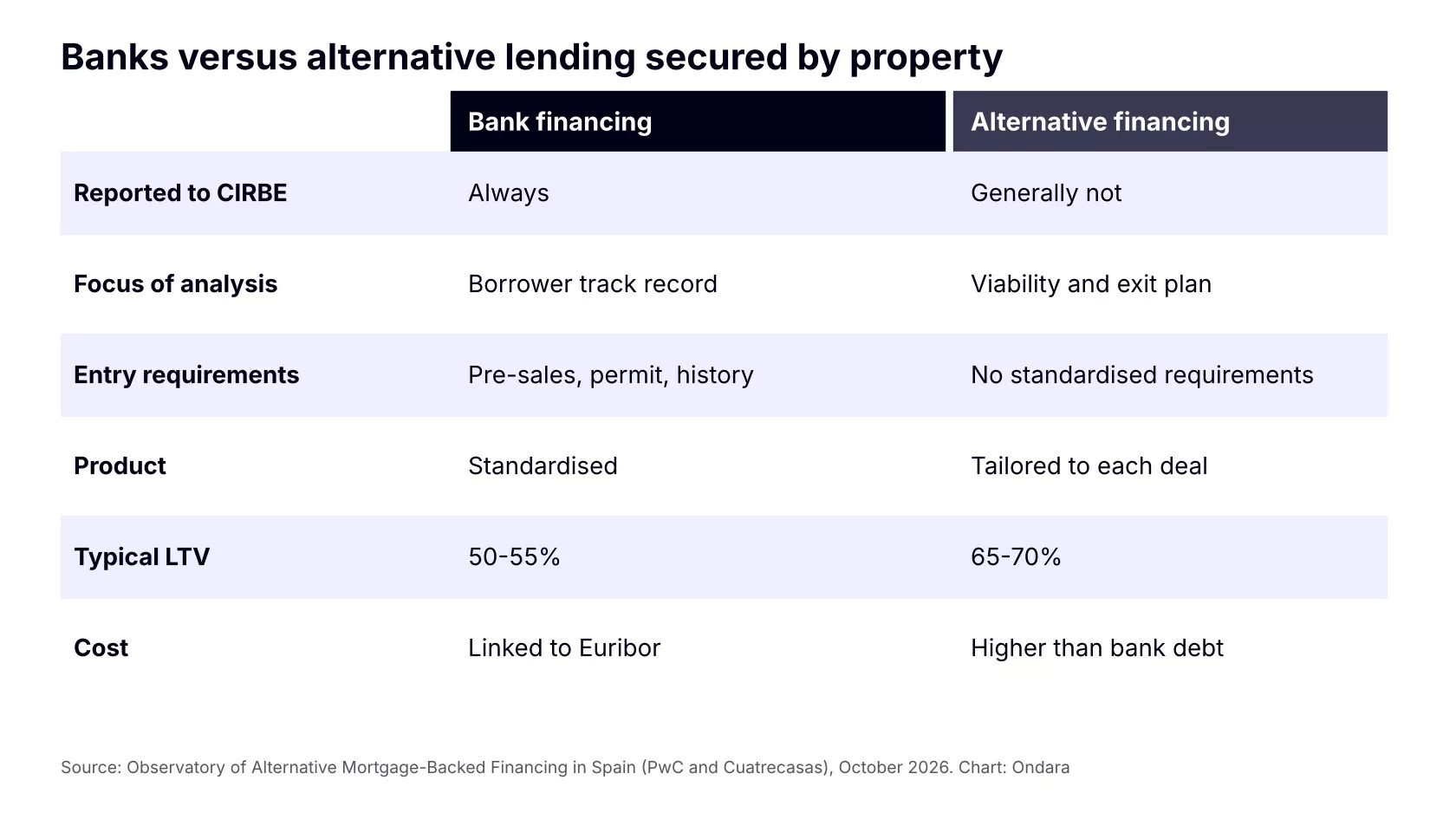
The Observatory lists other advantages for borrowers. The loan-to-value ratio (LTV: loan as a share of the asset’s value) can reach 65-70%, against the 50-55% usual in banking. Deals have been closed in under a month from receipt of documents, and repayment can be structured as a single payment at maturity (bullet) or interest-only.
There are trade-offs: higher cost, closer monitoring and terms tied to the exit plan. A higher LTV also leaves less margin if the asset’s value falls.
Trends: what is happening worldwide and in Spain
- Worldwide (13 October 2026). Chapter 1 of the IMF’s Global Financial Stability Report says markets are resilient, but that rising leverage and contingent liquidity risks in private credit could amplify episodes of stress.
- Spain (24 July 2026). According to the Banco de España note (in Spanish) on the second-quarter SAFE survey, access to bank financing kept improving, but loan rates rose for a second consecutive quarter and the financing-obstacles indicator worsened slightly for SMEs.
- Spain (October 2026). The Observatory forecasts EUR 3,891 million of alternative mortgage-backed financing in 2026 (+51%). It is a forecast, not final data.
What it means for an individual investor: if private capital gains weight and these deals do not pass through bank registers, due diligence by the manager and by you becomes more important.
What it means for the investor
- More of your own analysis. There is no common register to check the borrower’s total debt. Ask how the manager verifies it.
- Collateral and valuation. Look at the mortgage rank, the appraisal and the LTV.
- Exit plan. It must be realistic: a sale, bank refinancing or another identified source of repayment.
- Regular information. Ask how the deal will be reported while it lasts.
Ondara works with real assets as collateral, analyses each transaction individually and seeks diversification, with direct access to the management team since 2018. You can read who we are. Ondara seeks target double-digit returns, which are never guaranteed.
Risks to consider
All investments carry risk, including partial or total loss of capital. Property collateral mitigates risk but does not eliminate it.
- Default risk. If the borrower does not pay, recovering capital may require a slow enforcement process.
- Lower visibility. Without a common register it is harder to learn about the borrower’s other debts.
- Collateral value. A high LTV reduces the margin if prices fall.
- Illiquidity and term. Exiting before maturity may not be possible, and delays extend the term.
- Regulatory risk. The Observatory itself points to possible future regulation of debt funds.
Frequently asked questions
What is CIRBE?
It is the Banco de España’s database of the credit risks that reporting institutions hold with their clients. It is not a register of defaulters.
Does alternative lending appear in CIRBE?
According to the Observatory, generally not. It depends on who grants the financing and on each case, so take advice.
Does that mean the debt does not exist for the borrower?
No. It is a real obligation, with its collateral, deadlines and consequences if unpaid.
What LTV does alternative lending usually offer?
The Observatory cites 65-70%, against the 50-55% usual in banking. It is a market reference, not a fixed condition.
What should an investor check?
The collateral, the LTV, the term, the exit plan and the information you will receive during the deal.
In summary
- CIRBE records bank risks; alternative lending secured by property is generally not reported.
- The cause is a different regulatory framework, not a lack of discipline: collateral and project analysis structure the deal.
- Higher LTV, speed and flexibility come with higher cost and closer monitoring.
- For the investor, less public visibility calls for more of your own analysis.
- All investments carry risk, including the loss of capital.
If you would like to know how we invest, register as an investor and we will explain how it works. The minimum investment is EUR 25,000.
This article is for information purposes only and does not constitute an investment recommendation or financial advice. All investments carry risks, including the possible loss of the capital invested, and past or target returns do not guarantee future returns. Analyse each opportunity with a professional before investing.