Alternative development loan in Spain: how it works
An alternative development loan is construction financing provided by a non-bank lender that lets a developer start building with fewer pre-sales than a bank usually requires, in exchange for a higher financing cost. For investors, it is one of the most common forms of private debt secured on real estate.
This text is for information only. It is not investment advice.
What an alternative development loan is
A development loan finances the construction of a residential scheme: the lender releases the money as the works progress. An alternative development loan works the same way, but it is provided by a specialist fund or platform rather than a bank.
According to the Observatory of Alternative Financing with Mortgage Collateral in Spain, with market analysis by PwC and legal framework by Cuatrecasas (October 2026), it is the most widespread product: 86% of the lenders surveyed offer it. That is more than bridge loans (82%) and special situations (64%).
| Instrument | Lenders using it |
|---|---|
| Development loan | 86% |
| Bridge loan | 82% |
| Special situations | 64% |
| Other | 18% |
How it works: drawdowns by construction milestone
The mechanism is similar to a bank development loan. The money is not paid out at once, but by construction milestones checked by an independent certifier. The lender therefore pays out according to what has already been built.
- Security: usually a mortgage over the land and the works in progress.
- Drawdown: in tranches, after technical certification of each stage.
- Exit: the sale of the homes, or refinancing with a long-term bank loan.
That last piece is the logic of the bridge-to-term model: the alternative lender covers the initial stage and, once the works are well advanced, a bank steps in. According to the Observatory, the bank usually joins when pre-sales are around 50%.
Why it is used: starting works with fewer pre-sales
Banks usually ask for a high share of pre-sales before opening the credit line. According to the Observatory, alternative financing allows a developer to start with fewer. The report highlights an economic consequence: by selling when the works are more advanced, the developer may achieve better prices and a faster absorption rate, and in most cases that offsets the higher financing cost.
“In most cases” does not mean “always”. That is why it is worth understanding the arithmetic.
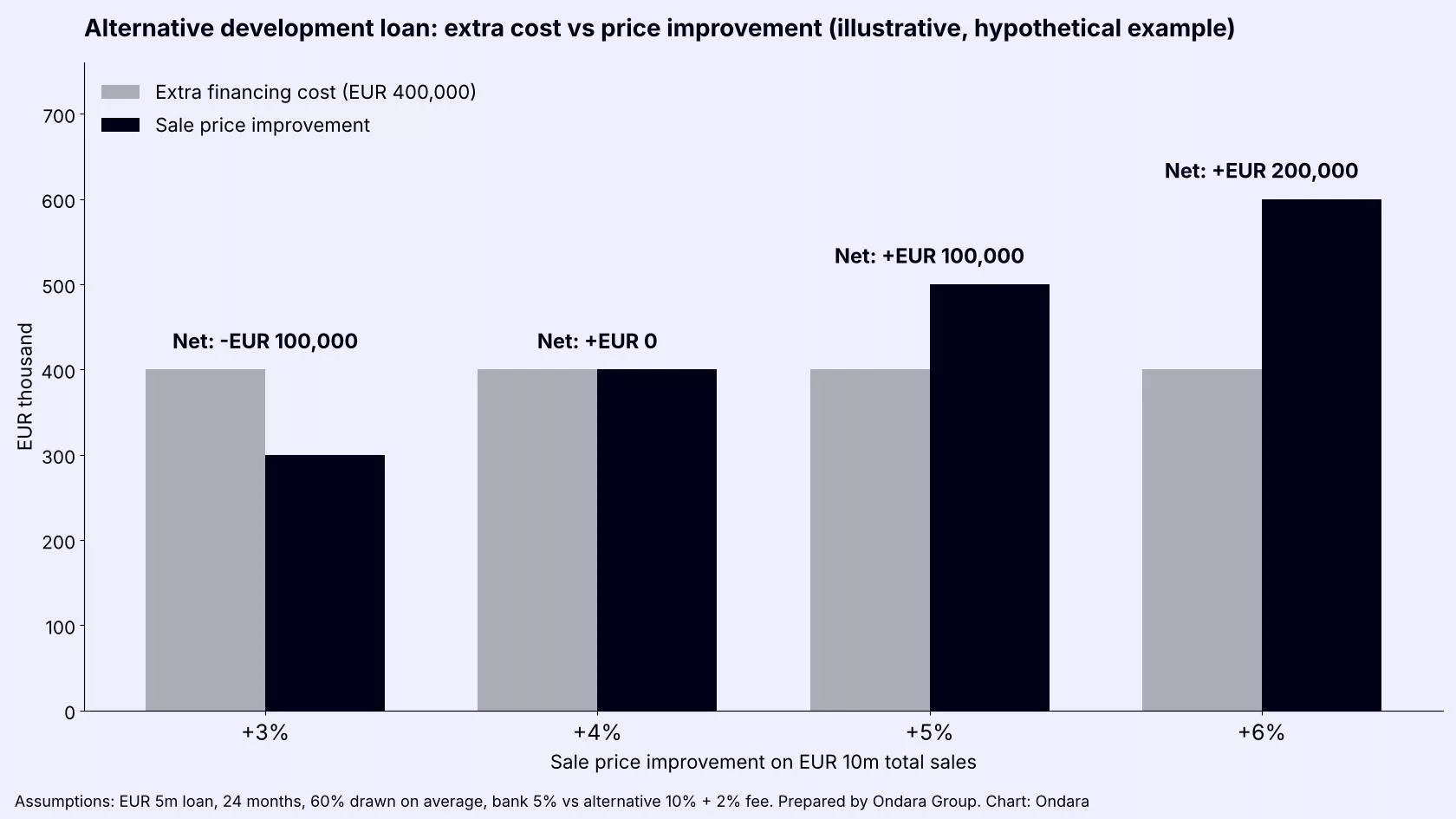
Illustrative, hypothetical example: extra cost versus price improvement
Suppose a scheme with total sales of EUR 10 million and a EUR 5 million loan over 24 months. On average, 60% of the loan is drawn. We compare a bank loan at 5% with an alternative loan at 10% plus a 2% fee.
| Item | Bank | Alternative |
|---|---|---|
| Interest (24 months) | EUR 300,000 | EUR 600,000 |
| Fee | EUR 0 | EUR 100,000 |
| Total cost | EUR 300,000 | EUR 700,000 |
The extra cost of the alternative loan is EUR 400,000, or 4% of sales. The deal pays off for the developer only if the sale price improves by more than 4%. With a 3% improvement, the developer loses EUR 100,000; with 5%, it gains EUR 100,000; with 6%, it gains EUR 200,000.
These figures are invented to explain the reasoning. They are not data from any transaction or a market forecast.
Average market terms
The Observatory gives the average terms of alternative debt with mortgage collateral in 2025. They cover all products, not just development loans.
| Term | Average | Range |
|---|---|---|
| Loan to value (LTV) | 55% | 30%-68% |
| Interest rate | 10% | 7%-20% |
| Maturity | 28 months | 11-72 months |
| Average loan size | EUR 4.9m | EUR 0.8m-58.3m |
For the wider market picture, see our summary of the Observatory.
Trends: what is happening worldwide and in Spain
- Euro area, 29 October 2026. The ECB left rates unchanged (deposit facility at 2.50%) and did not commit to a future path. A high cost of money makes any development more expensive. Source: ECB, monetary policy decision.
- Europe, 8 September 2026. A UK real estate credit manager announced that its flagship vehicle had passed GBP 500 million in commitments and that it plans to source 20% of its financing from countries such as Spain and Portugal. It is a sign of more private capital interested in funding development. Source: Alternative Credit Investor.
- Spain, October 2026. The Observatory estimates that alternative financing with mortgage collateral will reach EUR 3,891 million in 2026, 51% more than in 2025, and notes that bank credit to construction and real estate activities has fallen by 80% since 2008, according to the Banco de España (Spain’s central bank). Source: PwC.
For an individual investor, the reading is twofold: there is more demand for this kind of debt, but also more supply and more competition among lenders. It pays to look at the quality of each transaction, not only the interest rate.
Risks to consider
- Construction risk: delays, cost overruns or problems with the contractor can extend the term.
- Sales risk: if homes sell more slowly or for less than planned, repayment becomes harder.
- Valuation risk: the value of the collateral can fall; for land and works in progress it is harder to estimate.
- Illiquidity and term: capital is tied up and transactions may be extended.
- Loss of capital: every investment carries risk, including partial or total loss of capital. Real estate collateral mitigates risk but does not remove it.
How Ondara Group works
Since 2018, Ondara Group, based in Barcelona, has structured private debt transactions secured on real estate and distressed asset deals. We analyse each transaction individually, with real properties as collateral, we aim to diversify and we keep direct contact with the management team. The minimum investment is EUR 25,000. You can meet the team on who we are and see the group’s companies on our brands.
We do not offer guaranteed returns: any figure is a target and may not be achieved.
Frequently asked questions
What is an alternative development loan?
It is a loan to finance the construction of a scheme, provided by a fund or platform instead of a bank, with drawdowns by construction milestone.
Is it more expensive than a bank loan?
Usually yes. In return, it allows works to start with fewer pre-sales and on different decision timelines.
Who checks construction progress?
An independent certifier verifies each milestone before the next tranche is paid, as in a bank development loan.
What happens if the developer sells below plan?
Repayment may be delayed or reduced. The mortgage helps recover capital but does not ensure it is recovered in full.
Can an individual investor take part?
It depends on the vehicle and the investor’s profile. At Ondara, the minimum investment is EUR 25,000 and each opportunity is explained individually.
In summary
- 86% of alternative lenders offer development loans, according to the October 2026 Observatory.
- They are drawn by construction milestones checked by an independent certifier.
- They let a developer start with fewer pre-sales, at a higher financing cost.
- In the illustrative, hypothetical example, it pays off if the price improves by more than 4%.
- There are construction, sales, valuation and illiquidity risks, and part or all of the capital can be lost.
If you would like to know how we invest, register as an investor and we will explain how it works. The minimum investment is EUR 25,000.
This article is for information purposes only and does not constitute an investment recommendation or financial advice. All investments carry risks, including the possible loss of the capital invested, and past or target returns do not guarantee future returns. Analyse each opportunity with a professional before investing.