Flex Living and Build-to-Rent Financing in Spain
Financing for flex living and build-to-rent in Spain comes largely from alternative lenders: 68% of them finance flex living and 41% build-to-rent, according to the Observatorio de Financiación Alternativa con Colateral Hipotecario en España, with market analysis by PwC and legal framework by Cuatrecasas (October 2026). These are new formats and banks do not yet have the track record to value them. Here is what they are, why private capital moves first and what risks an investor faces.
This text is for information only. It is not investment recommendation or financial advice.
What flex living and build-to-rent are
Build-to-rent (BTR) means developing homes to keep them as rentals rather than sell them. Flex living is furnished, flexible, medium-stay rental with services included. Other formats sit alongside them: student housing, senior living and logistics.
They share one feature: they are financed on expected income, not on a sales track record. To see how this kind of debt is structured, read our guide to alternative mortgage lending in Spain.
Alternative financing for new property assets: which segments it funds
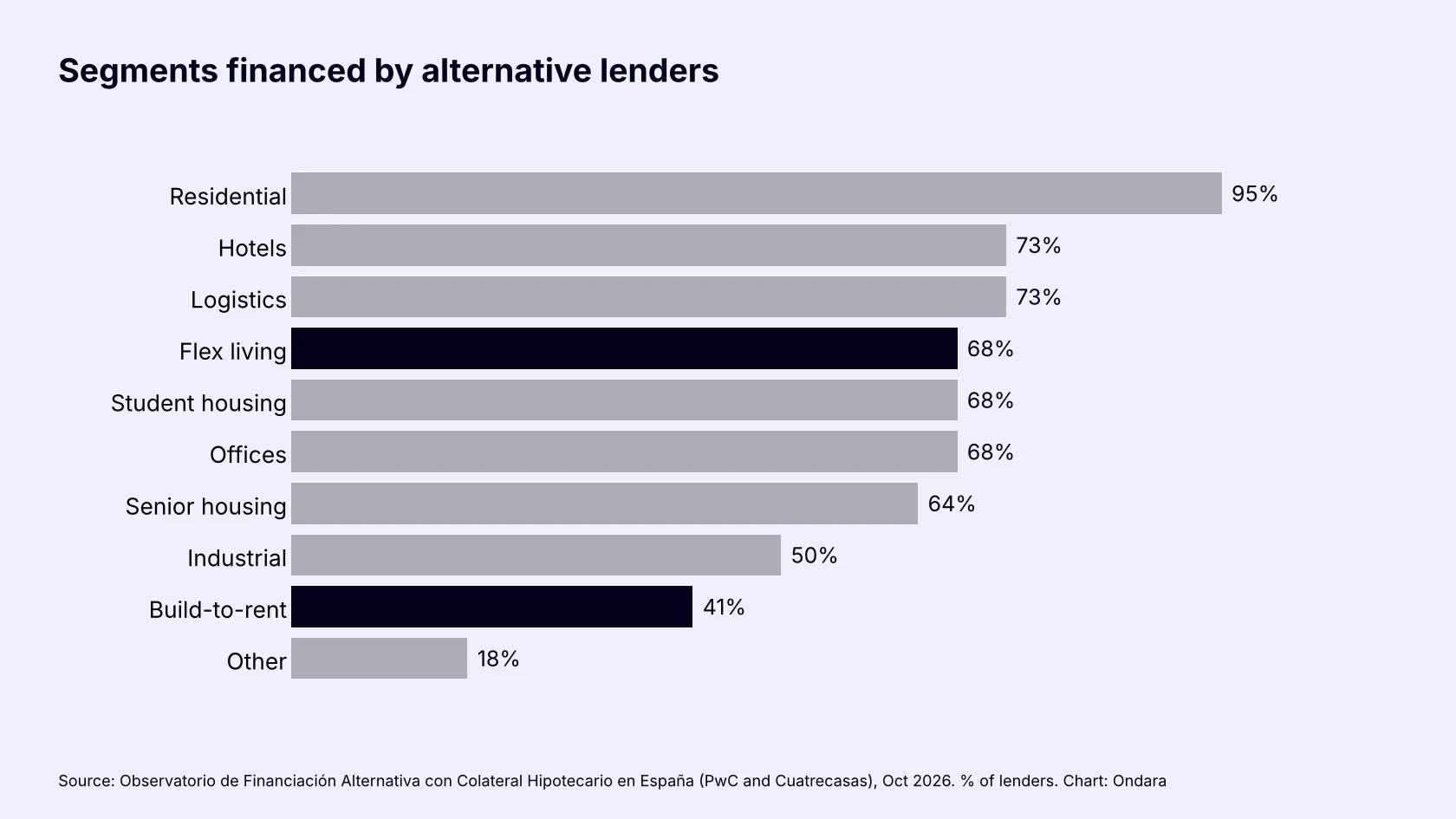
The Observatorio asks alternative lenders which segments they finance. Residential leads by a wide margin. Flex living and student housing are level; build-to-rent sits lower.
| Segment | % of lenders financing it |
|---|---|
| Residential | 95% |
| Hotels | 73% |
| Logistics | 73% |
| Flex living | 68% |
| Student housing | 68% |
| Offices | 68% |
| Senior housing | 64% |
| Industrial | 50% |
| Build-to-rent | 41% |
| Other | 18% |
Why private debt moves first
Banks analyse track record: occupancy, rents and comparable deals. A new format has none of that. According to the Observatorio, this is where alternative financing steps in first, because it assesses the project and its exit plan.
- No comparables. Without reference transactions, valuation is harder.
- Tailored structure. Terms and drawdowns follow the project plan.
- Early phase. Construction and launch need capital before income is stable.
Once the asset stabilises, it is usually refinanced with long-term debt. This is the logic of bridge-to-term financing, whose legal keys we explain separately.
That flexibility has a price. The Observatorio notes a higher financing cost than banks, closer monitoring of the deal and terms tied to the exit plan. For an investor, the question is not only how much a format might yield, but who bears the loss if the plan slips and what collateral backs the debt.
Trends: what is happening worldwide and in Spain
- Europe (22 August 2026). An analysis by GRI Institute estimates that Basel IV rules open a financing gap of about EUR 250 billion in European real estate. According to Savills, cited in the same piece, residential and care-home sectors make up almost 30% of European investment.
- Spain, regulation and BTR (10 June 2026). According to idealista, reporting Cushman & Wakefield’s Spain Living Investor Survey 2026, rental regulation has stalled almost all new BTR development in Barcelona, and capital is shifting to unit-by-unit sales. Student housing is the segment most investors have on their radar (75%).
- Spain, logistics (28 July 2026). Cushman & Wakefield reports that logistics leasing passed one million square metres in the first half of 2026, with availability below 3.5% in Barcelona.
- Spain, flex living (29 June 2026). According to idealista, DWS sees flex living as a segment starting from a small base that demands more operations and upfront financing than conventional residential rental.
These are consultancy and press figures, with different dates and scopes, and may change. For a private investor the reading is sober: there is demand for capital in these formats, but also more regulatory and operating uncertainty.
Logistics: the asset with the longest statistical record
Logistics has more history than flex living. Spain’s stock grew from 28.7 to 34.7 million m² between 2020 and 2025, and 36.2 million is forecast for 2026.
| Year | Logistics stock (million m²) |
|---|---|
| 2020 | 28.7 |
| 2022 | 31.0 |
| 2024 | 33.5 |
| 2025 | 34.7 |
| 2026 (forecast) | 36.2 |
According to the same report, Madrid holds around 45% of the stock and Barcelona between 31% and 32%.
How Ondara looks at it
Ondara Group structures private debt transactions with real assets as collateral and has worked with direct access to the management team since 2018. We analyse each transaction individually: the asset, the exit plan and the guarantees. The minimum investment is EUR 25,000. You can learn more about the team.
Risks to consider
- Risk of capital loss. All investments carry risk, including partial or total loss of capital. Property collateral mitigates it but does not eliminate it.
- Regulatory risk. Rent caps and tensioned-area rules can change a project’s expected income.
- Operating risk. Flex living and student housing depend on an operator and on occupancy.
- Valuation. Without comparables, the value of the collateral is less certain.
- Illiquidity and term. A delayed exit lengthens the investment.
- Provisional data. Market forecasts are estimates, not guarantees.
Frequently asked questions
What is flex living?
It is furnished, flexible medium-stay rental with services. It sits between residential rental and a hotel.
What is the difference between build-to-rent and flex living?
Build-to-rent is developed for long-term letting. Flex living offers shorter stays and services.
Why do banks finance these assets less?
Because they lack a track record and comparable deals. Alternative financing assesses the project and its exit plan.
Which segments do alternative lenders finance most?
According to the Observatorio, residential (95%), hotels and logistics (73%) and then flex living (68%).
What risks come with investing in these assets?
There are default, regulatory, operating and illiquidity risks, and part or all of the capital may be lost.
In summary
- 68% of alternative lenders finance flex living; 41% finance build-to-rent (Observatorio, October 2026).
- New formats lack a bank-style track record, so private debt moves first.
- Rental regulation weighs on BTR, especially in Barcelona.
- Logistics has more history and data than flex living.
- All investments carry risk, including loss of capital.
If you would like to know how we invest, register as an investor and we will explain how it works. The minimum investment is EUR 25,000.
This article is for information purposes only and does not constitute an investment recommendation or financial advice. All investments carry risks, including the possible loss of the capital invested, and past or target returns do not guarantee future returns. Analyse each opportunity with a professional before investing.