Real estate debt bonds in Spain: how they work
A real estate debt bond is a fixed-income security through which a developer, an owner or a debt vehicle raises financing by issuing notes that several investors subscribe to, usually backed by a mortgage. In Spain they are mostly issued without a public offer and are often admitted to trading on MARF, the alternative fixed-income market run by BME, the Spanish exchange operator. Here is how they work, which legal framework applies and what risks an individual investor faces.
This text is educational. It is not an investment recommendation or financial advice.
Real estate debt bonds: what they are and why they are issued
A property transaction can be financed with a loan from one lender or with bonds spread across many holders. With bonds, the issuer splits the debt into smaller securities and places them with investors. For the issuer, this is another source of funding alongside banks and alternative lending backed by mortgage collateral.
The Observatory of Alternative Financing with Mortgage Collateral in Spain (October 2026), with market analysis by PwC and the legal framework by Cuatrecasas, distinguishes two structures: downstream and upstream.
| Aspect | Downstream | Upstream |
|---|---|---|
| Who issues | The developer or owner of the asset | The debt vehicle |
| Purpose | To finance a specific asset | To expand its own lending capacity |
| Best suited to | Assets with stable cash flows: offices, hotels, logistics | Vehicles that want more capacity without relying only on their partners |
| Advantage cited | Structure tied to a secured asset | Access to institutional investors and better matching of asset and liability maturities |
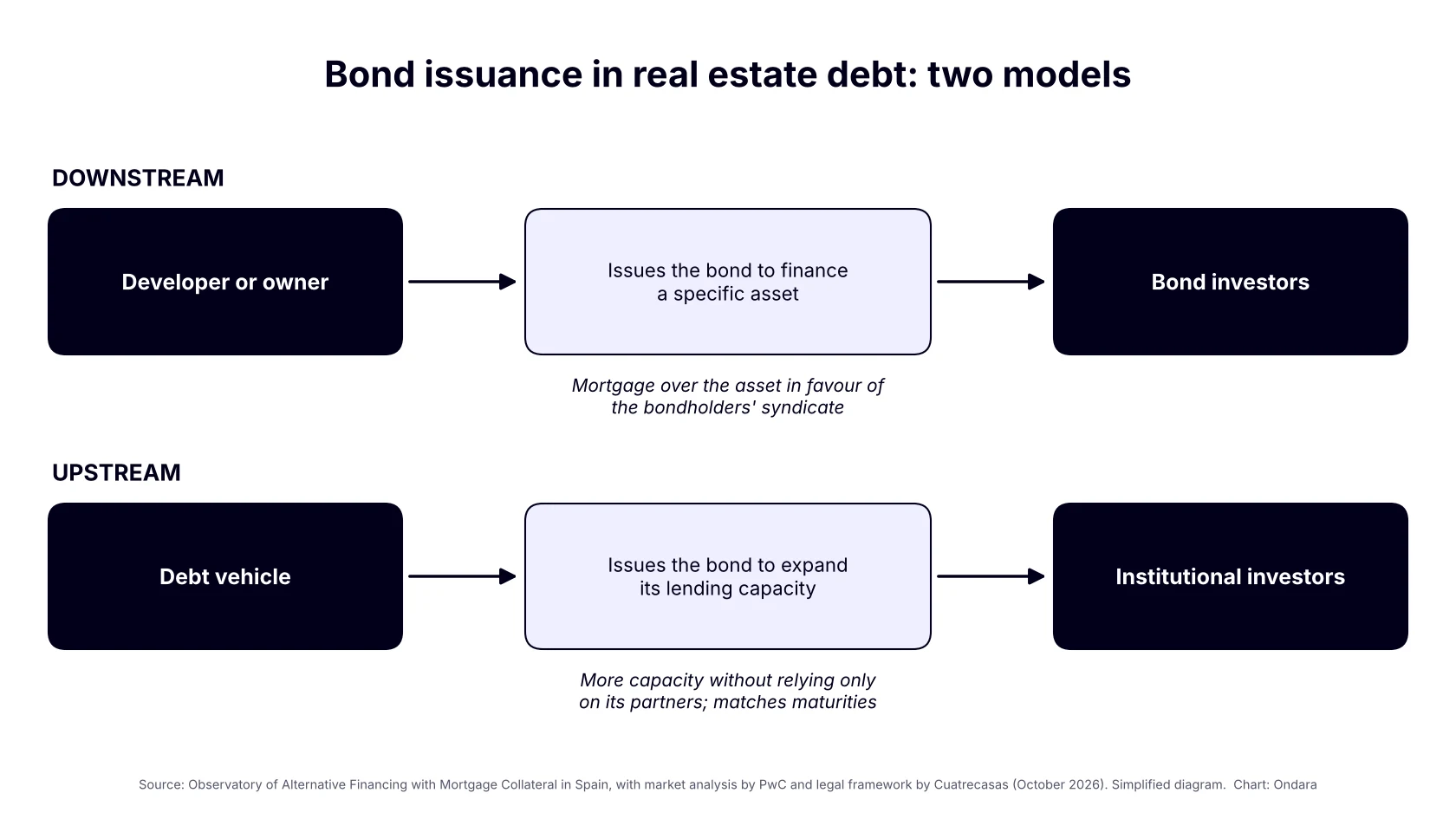
How a bond issue backed by a mortgage works
For the investor, the key is the security. According to Cuatrecasas, the mortgage is granted in favour of the bondholders’ syndicate, which represents the holders through a commissioner. The mortgage stays registered even if the bonds change hands, so a buyer in the secondary market does not need a new security.
- Issue: the issuer sets the amount, term, interest and security, and records them in the issue documentation.
- Security: the mortgage over the asset is registered in favour of the bondholders’ syndicate.
- Representation: the commissioner acts on behalf of the bondholders.
- Admission to trading: optional, for example on MARF, to make the bonds easier to transfer.
To see how construction finance is sequenced, read our guide to bridge-to-term real estate financing and its legal keys.
Spanish legal framework: the essentials
The legal chapter of the Observatory, written by Ana M.ª Gamazo and Javier Calle (Cuatrecasas), summarises the rules worth knowing. It is an overview, not an analysis of a specific case.
| Rule | What it provides |
|---|---|
| Arts. 401-433 of the Spanish Companies Act (LSC) | Regime for issuing bonds and for the bondholders’ syndicate |
| Additional Provision 1 of Law 10/2014 | Withholding tax exemption for non-residents on issues admitted to trading |
| Law 5/2015 | Limited companies may issue up to twice their equity, with no cap if secured by a mortgage |
| Law 6/2023 | Simpler admission to trading on BME |
| Regulation (EU) 2017/1129 | Prospectus exemption when there is no public offer |
Rules change. Before deciding, check the current text in Spain’s official gazette (BOE) or with a legal adviser.
Why interest in real estate fixed income is growing
The Observatory lists several reasons why issuers and investors are looking at bonds:
- Institutional investors: many European insurers and pension funds can only invest in securities, not in direct loans.
- Green bonds: they appeal to investors with ESG criteria.
- Financing gap: according to LaSalle IM (2025), cited by the Observatory, Europe faces a real estate financing gap of more than EUR 250 billion through 2030.
- Upfront costs: legal, rating, placement and admission costs weigh, although standardisation by ICMA and AFME eases them.
Trends: what is happening worldwide and in Spain
- Spain, 15 October 2026. MARF ended September with EUR 10,480 million outstanding and 166 issuing companies, 6% more than a year earlier, according to Forbes España (Europa Press). This is the general corporate fixed-income market, not only real estate.
- Spain, 14 May 2026. The Banco de España’s spring Financial Stability Report includes a box on the private credit market in Spain, which has grown notably.
- United States, 5 October 2026. According to KBRA’s monthly report, private-label CMBS issuance (bonds backed by commercial mortgages) reached USD 103.5 billion year to date through September, 11.9% more than a year earlier. KBRA warns that recent rate rises could slow the pace.
For an individual investor the reading is cautious: the real estate bond market is deepening, but a bond is the issuer’s debt and its value depends on the issuer paying. We have found no official 2026 figures for real estate bond issuance on MARF, so we do not give any.
Bonds versus a direct secured loan
In a direct loan, the investor finances a specific transaction and reviews it with the manager. With a bond, the ticket is smaller and the holding can be transferred, but there are issuance costs and less room to tailor terms. Here we cover a different question: how the debt is issued, not which to choose.
How Ondara approaches it
At Ondara Group we structure private debt transactions with real assets as collateral and have worked with direct access to the management team since 2018. We analyse each transaction individually and seek diversification. We aim for target double-digit returns, which are never guaranteed. The minimum investment is EUR 25,000. Learn who we are.
Risks to consider
- Loss of capital. All investments carry risk, including partial or total loss of capital. A mortgage mitigates risk but does not remove it.
- Issuer credit risk. If the issuer does not pay, the security must be enforced, which takes time and money.
- Illiquidity. A bond being tradable does not guarantee a buyer at the price you want.
- Asset valuation. The property’s value may fall and fail to cover the debt.
- Costs and complexity. Issues carry upfront costs and extensive documentation.
- Regulatory and tax changes. Exemptions and limits can change.
Frequently asked questions
What is MARF?
It is BME’s alternative fixed-income market, designed for mid-sized companies to issue bonds and commercial paper. It ended September 2026 with EUR 10,480 million outstanding.
What is a bondholders’ syndicate?
It is the grouping of the holders of an issue’s bonds, represented by a commissioner. In a mortgage-backed issue, the mortgage is registered in its favour.
What is the difference between downstream and upstream?
In downstream, the developer issues to finance an asset. In upstream, the debt vehicle issues to expand its lending capacity.
Is a prospectus required to issue bonds?
According to the Observatory, Regulation (EU) 2017/1129 provides a prospectus exemption when there is no public offer. A legal adviser should review each case.
Can you lose money investing in real estate bonds?
Yes. You can lose part or all of your capital if the issuer does not pay and the security does not cover the debt.
In summary
- A real estate debt bond splits financing into securities subscribed by several investors.
- There are two models: downstream (for one asset) and upstream (to expand a vehicle’s capacity).
- The mortgage in favour of the bondholders’ syndicate stays registered even if the bonds change hands.
- MARF exceeded EUR 10,000 million outstanding in September 2026, although it covers all kinds of issuers.
- All investments carry risk, including the loss of capital.
If you would like to know how we invest, register as an investor and we will explain how it works. The minimum investment is EUR 25,000.
This article is for information purposes only and does not constitute an investment recommendation or financial advice. All investments carry risks, including the possible loss of the capital invested, and past or target returns do not guarantee future returns. Analyse each opportunity with a professional before investing.