Real estate development equity in Spain: how it works
Real estate development equity is the capital that sits below the debt in a project: it fills the gap between what the senior lender provides and the developer’s own funds, and it is paid last. That is why it carries more risk and requires a higher target return. In Spain this segment moved EUR 273 million in 2025 and EUR 450 million is forecast for 2026, according to the Observatory. Here is how it works and what an individual investor should look at.
This text is for general information. It is not investment advice.
What is real estate development equity?
A residential project is financed in layers. First, the senior loan. Then, the developer’s own funds. A gap often remains between the two: the maximum leverage a senior lender accepts does not cover everything the developer cannot contribute. Alternative equity fills that gap.
Its main features, according to the Observatory of Alternative Financing with Mortgage Collateral in Spain, with market analysis by PwC and legal framework by Cuatrecasas (October 2026):
- The developer keeps managing the project. The investor does not take part in day-to-day operations.
- Returns come through dividends, project liquidation or a share of the result.
- It ranks last in the order of payment: the debt is paid first.
- Family offices tend to enter through this route.
Alternative equity in Spain: the figures
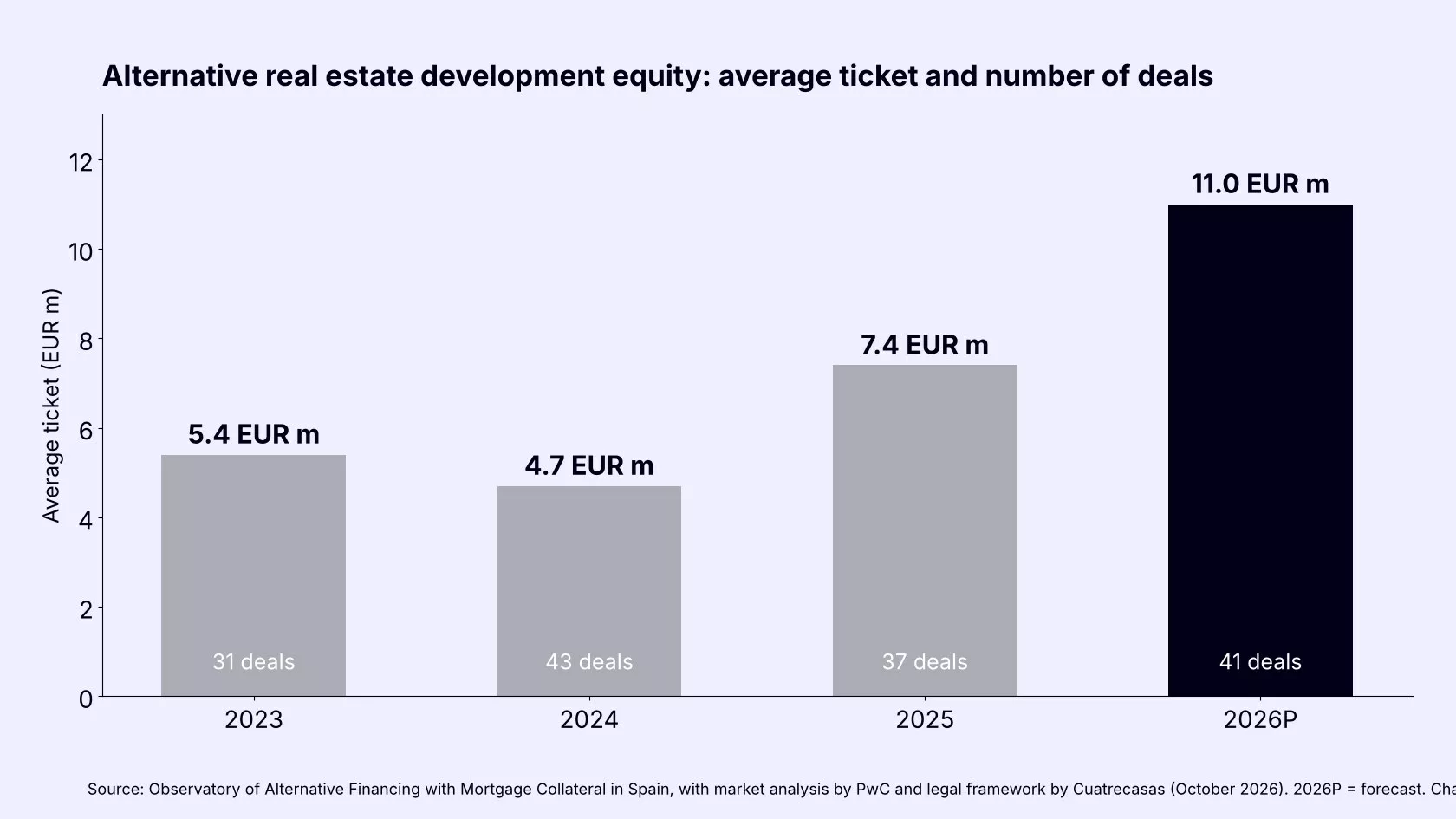
Alternative development equity grew from EUR 169 million in 2023 to EUR 273 million in 2025 (+27% a year). EUR 450 million is forecast for 2026, 65% more. It accounts for 10% to 12% of all alternative financing backed by mortgage collateral.
| Year | Volume (EUR m) | Deals | Average ticket (EUR m) |
|---|---|---|---|
| 2023 | 169 | 31 | 5.4 |
| 2024 | 201 | 43 | 4.7 |
| 2025 | 273 | 37 | 7.4 |
| 2026F | 450 | 41 | 11.0 |
The key point: the segment grows by size, not by number of deals. The average ticket rises 57% in 2025 and 49% in 2026F, while the number of deals barely moves (+9% a year). There are fewer, larger deals, not many more.
Trends: what is happening worldwide and in Spain
- Spain, October 2026: the Observatory forecasts that alternative financing backed by mortgage collateral will reach EUR 3,891 million in 2026, up from EUR 2,583 million in 2025. We break it down in alternative mortgage lending in Spain: 2026 figures. Residential development is covered in this other article, which uses a different measurement scope.
- Worldwide, 13 October 2026: the IMF’s Global Financial Stability Report notes that rising leverage and contingent liquidity risks in private credit could amplify a stress episode. For investors it is a reminder: the lower you sit in the capital structure, the more liquidity and selection discipline matter.
- Rates, 16 September 2026: the ECB raised its deposit facility rate to 2.50%, according to its official rates table. With higher rates, senior debt costs more and equity absorbs more pressure in tight projects.
What it means for an investor in Spain: equity is the tranche most sensitive to a change in the cycle. If sale prices or costs move, the first to feel it is whoever is paid last.
Illustrative example: why equity is paid last
Imagine a project with a total cost of EUR 10 million. This is an illustrative and hypothetical example, with no interest or fees, to show the order of payment:
- Senior debt: EUR 6.5 million.
- One investor’s equity: EUR 2.0 million.
- Developer’s own funds: EUR 1.5 million.
We assume the investor and the developer share what is left after repaying the debt in proportion to their contributions. Only the total sale price changes.
| Sales scenario | Revenue (EUR m) | After repaying debt (EUR m) | Equity investor receives (EUR m) |
|---|---|---|---|
| Base | 11.50 | 5.00 | 2.86 |
| Prices -10% | 10.35 | 3.85 | 2.20 |
| Prices -20% | 9.20 | 2.70 | 1.54 |
With a 20% fall in revenue, the senior debt is repaid in full, but the equity gets back less than it put in (1.54 versus 2.0). That is why equity requires a higher target return and why it is not suited to any share of a portfolio.
How Ondara works in this context
Ondara Group is an alternative investment manager based in Barcelona, active since 2018. We structure private debt transactions backed by real estate, analyse each one individually and work with real assets as collateral. Investors deal directly with the management team and the minimum investment is EUR 25,000. You can meet the team on the who we are page and see the group’s businesses under brands.
Risks to consider
Every investment carries risk, including partial or total loss of capital. With development equity, in addition:
- Subordinated position: it is paid after the debt and absorbs the first losses.
- Developer and construction risk: delays, cost overruns or licence issues can reduce the result.
- Market risk: if prices or sales pace fall, what is left after the debt shrinks.
- Illiquidity and term: capital is tied up until the project is liquidated.
- No operational control: the investor does not run the project.
- Data risk: 2026 is a forecast and market figures may be revised.
The real estate collateral backing the debt does not protect the equity: it mitigates the lender’s risk, not the shareholder’s.
Frequently asked questions
What is real estate development equity?
It is capital contributed to a project below the debt. It is paid last and, in return, has a higher target return and more risk.
How is it different from debt?
Debt has an agreed rate, maturity and collateral. Equity depends on the project’s result and has no collateral of its own.
How much alternative equity is there in Spain?
EUR 273 million in 2025 and EUR 450 million forecast for 2026, according to the Observatory with PwC analysis.
Why is the average ticket rising?
Because deals are bigger, not because there are many more. Between 2024 and 2026F the ticket goes from EUR 4.7 million to EUR 11.0 million.
Can an individual invest in real estate equity?
Yes, but with risk of capital loss and illiquidity. Each project should be reviewed with a professional before investing.
In summary
- Equity fills the gap between senior debt and the developer’s own funds, and is paid last.
- It moved EUR 273 million in 2025, with EUR 450 million forecast for 2026 (Observatory, PwC).
- The segment grows through deal size, not deal count.
- A higher target return means more risk, including loss of capital and illiquidity.
If you would like to know how we invest, register as an investor and we will explain how it works. The minimum investment is EUR 25,000.
This article is for information purposes only and does not constitute an investment recommendation or financial advice. All investments carry risks, including the possible loss of the capital invested, and past or target returns do not guarantee future returns. Analyse each opportunity with a professional before investing.