Bridge-to-term real estate financing: legal keys
The bridge-to-term model combines a bridge loan from an alternative lender during the development phase with a bank loan during construction. According to the legal analysis by the law firm Cuatrecasas in the Observatory of Alternative Financing with Mortgage Collateral in Spain (October 2026), its success depends on planning the contracts, milestones and collateral from day one. In this article we summarise the report’s main legal and tax points and what they mean for anyone investing in real estate-backed debt.
This article is for information only. It is not investment, legal or tax advice.
What the bridge-to-term model is
The authors (Manuel Follia and Javier Rodríguez, of Cuatrecasas) describe it as a fund-bank partnership, mostly in new real estate projects, in two phases:
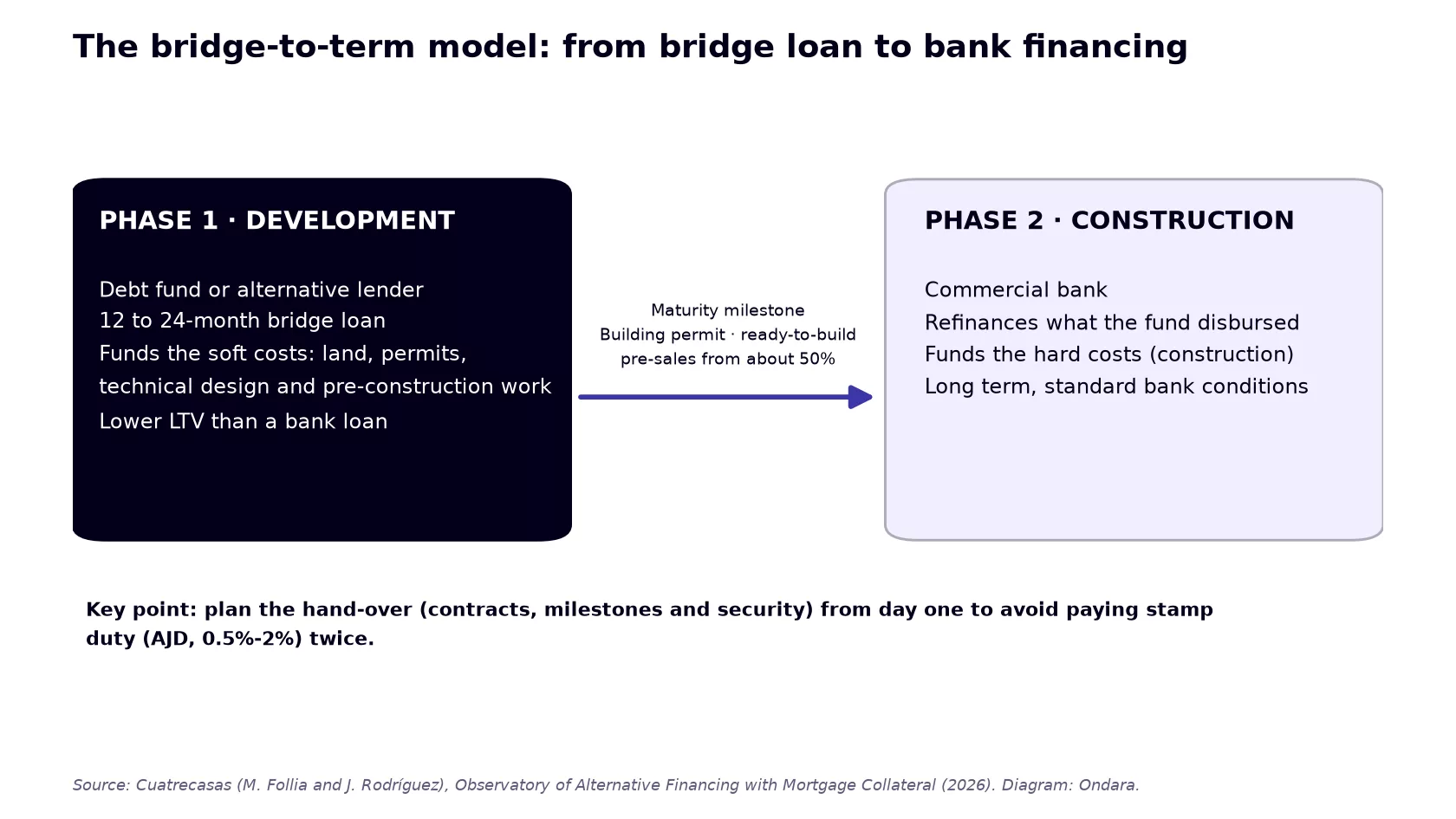
- Development phase: a debt fund or alternative lender grants a bridge loan for the soft costs: land acquisition, permits, technical design and preparatory work. The usual term is 12 to 24 months, with a lower LTV than a bank would offer.
- Construction phase: once the project matures (building permit, ready-to-build status, pre-sales typically from around 50%), a commercial bank refinances what the fund has disbursed and funds the hard costs, meaning the construction itself.
Each lender sits on its own part of the risk-return curve, and the developer obtains financing at a stage when a bank would not lend. The report notes that funds and banks increasingly know each other in advance and agree the basic terms of the long-term loan before the bridge loan is signed.
The hidden cost: paying stamp duty twice
In Spain, every mortgage that is created is subject to Stamp Duty on Documented Legal Acts (AJD), at a rate of 0.5% to 2% of the secured amount depending on the region. If, when moving from the fund to the bank, one mortgage is cancelled and a new one is created, the project pays AJD twice.
Illustrative and hypothetical example: with a mortgage liability of EUR 5 million and a 1.5% rate, each mortgage costs EUR 75,000 in AJD. Doing it twice means EUR 150,000 that does not go into the project.
Cuatrecasas points to three ways to mitigate this, each requiring specialist advice:
| Option | How it works | What to weigh up |
|---|---|---|
| Promise to grant a mortgage | The mortgage is committed but not created, so AJD is deferred until it is formalised. It relies on a pledge over the shares of the project company, non-disposal and negative pledge undertakings and irrevocable powers of attorney | Security that replaces the mortgage, but is not identical to it |
| Multi-tranche financing | A single deal with a development tranche and a construction tranche, signed by all parties from the start and secured by one mortgage | AJD is paid only once |
| Subrogation (Law 2/1994) | Applying the tax benefits of loan subrogation to funds and alternative lenders | The most complex route; no practical experience yet, according to the report |
Direct sale: an alternative to court enforcement
Court-based mortgage enforcement in Spain tends to be slow, costly and uncertain, and the property is often sold at auction below its value. The authors Víctor Utges and Guillermo Ruiz (Cuatrecasas) analyse direct sale, known in Spain as the pacto marciano: an agreement under which, if the borrower defaults, the lender takes the asset or sells it to a third party without an auction, always at a price set by an objective valuation at the time of default.
Articles 1859 and 1884 of the Spanish Civil Code prohibit the lender from simply keeping the asset given as security (the so-called pacto comisorio). However, Spain’s Directorate General for Legal Certainty and Public Faith (DGSJFP) and the Supreme Court accept direct sale if it meets these requirements:
| Requirement | What it means |
|---|---|
| Good faith and freedom of contract | Freely agreed, not imposed on a borrower in a situation of abuse or need |
| Balance between the parties | No unjust enrichment: if the asset is worth more than the debt, the difference belongs to the borrower |
| Objective, independent valuation | A procedure agreed from the start to set the value at the time of enforcement, usually a third-party valuation |
| Return of any surplus | Anything above the debt goes to the borrower or to later creditors, usually through a notarial deposit |
| Notary involvement | Payment demand, notice to other creditors and completion before a notary; reviewed case by case |
| Deals between professionals | Designed for companies; with consumers, Law 5/2019 on real estate credit severely restricts it |
The report cites the DGSJFP Resolution of 26 December 2018 and the Supreme Court Judgment of 21 February 2017 as references. Compared with auctions, direct sale offers more speed, lower costs, a more predictable timeline, less litigation and better use of the asset’s value.
Industrialised construction: collateral that does not fit
A traditional development loan is secured by a mortgage over what has been built on the plot. Carlos Lasarte (Cuatrecasas) explains that in industrialised construction much of the value is manufactured off-site, and Article 334.1 of the Civil Code only treats buildings attached to the land as real estate. He therefore suggests structuring the financing in two tranches: an industrial one (secured by a non-possessory pledge or chattel mortgage) and a developer one (real estate mortgage). The industrial tranche would be refinanced by the developer tranche once the modules are assembled on site.
Bonds as a lever for lenders
Ana M.ª Gamazo and Javier Calle (Cuatrecasas) highlight bond issuance as a way for real estate debt vehicles to expand their capacity (upstream financing) or for a developer to fund an asset (downstream financing). The legal framework has become simpler:
- The first additional provision of Law 10/2014 extends a favourable tax regime to Spanish companies’ listed issues, with no withholding tax for non-resident investors if the requirements are met.
- Law 5/2015 allowed limited liability companies to issue bonds, capped at twice their equity unless the issue is secured by a mortgage.
- Law 6/2023 on Securities Markets simplified admission to trading, for example on Spain’s alternative fixed-income market (MARF).
Trends: what is happening worldwide and in Spain
- Worldwide: direct lending was born in the United States with the large alternative asset managers and reached Europe between 2012 and 2014, first the UK and France, then Germany, Spain, Italy, the Benelux and the Nordic countries.
- Europe: the report cites a LaSalle Investment Management estimate (2025) putting Europe’s real estate financing gap above EUR 250 billion until 2030, driven by maturities, lower bank LTVs and CRR3.
- Spain: real estate is the main sector for direct lending (residential development, logistics, offices, student housing, hotels and flex living), according to Cuatrecasas.
What it means for investors
Collateral is only as good as your ability to enforce it. When investing in mortgage-backed debt, ask who reviewed the documents, whether the contract is designed for a hand-over to a bank, what happens if the borrower defaults and whether there is a valid direct sale agreement. A well-designed structure does not remove risk, but it makes recovery more predictable.
Risks to consider
- Default and timing risk: recovery can take longer than planned, especially through the courts.
- Legal risk: courts review each direct sale agreement case by case, and a poorly drafted one can be void.
- Regulatory risk: stronger debtor protection between professionals would affect the market, according to the report.
- Valuation and liquidity risk: the property’s value can fall, and capital is locked in for the term.
How we work at Ondara
At Ondara we grant bridge loans secured by first-ranking mortgages over properties valued by an independent third party, to companies, property owners and real estate investors. We have our own legal arm, Ondara Legal, working with the law firm Valls Guiu Abogados, which reviews the documents and collateral of every deal and, if needed, handles enforcement and recovery of possession. Our investors choose deal by deal, from EUR 25,000, with terms of 12 to 36 months and target double-digit returns, which are never guaranteed. Learn more on who we are and our brands, or read our overview of alternative mortgage-backed lending in Spain in 2026.
Frequently asked questions
What is bridge-to-term financing?
A model in which an alternative lender provides a bridge loan during development and a bank refinances it for construction once the project meets its requirements.
Why might stamp duty be paid twice?
Because if the fund’s mortgage is cancelled and a new one is created for the bank, each mortgage is taxed. Structures such as multi-tranche financing avoid this.
Is a direct sale agreement legal in Spain?
Yes, if it meets the requirements of the DGSJFP and the Supreme Court: objective valuation, return of any surplus, good faith, balance between the parties and notary involvement, mainly between professionals.
Can a direct sale be agreed with a consumer?
Hardly: Law 5/2019 on real estate credit greatly restricts that freedom when the borrower is a consumer.
What should I check as an investor in mortgage-backed debt?
The mortgage ranking, the valuation, the LTV, the loan documents, the exit plan and how the collateral would be enforced. Do it with a professional.
In summary
- Bridge-to-term links an alternative bridge loan and a bank loan across two phases of the same project.
- Planning the hand-over avoids costs such as paying AJD twice (0.5%-2% of the secured amount).
- Direct sale is a recognised way to enforce collateral without an auction, subject to strict requirements.
- Industrialised construction and bonds are opening up new financing structures.
- All investments carry risk, including capital loss and illiquidity.
If you would like to know how we analyse and structure each deal, register as an investor and we will explain how it works. The minimum investment is EUR 25,000.
This article is for information purposes only and does not constitute an investment recommendation or financial advice. All investments carry risks, including the possible loss of the capital invested, and past or target returns do not guarantee future returns. Analyse each opportunity with a professional before investing.