Alternative mortgage lending in Spain: 2026 figures
Alternative mortgage-backed lending in Spain reached EUR 2,583 million in 2025 and could hit EUR 3,891 million in 2026, a 51% increase. These are the figures from the first Observatory of Alternative Financing with Mortgage Collateral in Spain, with market analysis by PwC and a legal framework by the law firm Cuatrecasas, published in October 2026. It is the first time this market has been measured systematically. Below we summarise its main data and charts and explain where Ondara fits in.
This article is for information only. It is not investment advice.
What alternative mortgage-backed lending is
The report defines it as financing granted by non-bank lenders to developers and companies in any sector, secured by a mortgage over real estate. The mortgage structures the deal, sets its terms and determines the order of repayment if something goes wrong.
It mainly takes three forms of debt, from lower to higher risk, with equity as a complement:
- Development loan: funds the construction of a project, drawn down against construction milestones verified by an independent third party.
- Bridge loan: covers a short-term liquidity need when a source of repayment has been identified but has not yet materialised, such as a signed sale that will complete in a few months. It is usually bullet and secured by a first-ranking mortgage.
- Special situations: liquidity for companies in restructuring or financial stress that still hold valuable assets.
- Equity: capital that completes the structure when debt reaches its limit, without taking control of the project.
Why it exists: banks pulled back from the riskiest segment
At the end of 2008, bank lending to real estate and construction in Spain peaked at EUR 496,757 million, around 45% of that year’s GDP. In 2025 the outstanding balance stood at EUR 100,494 million: 80% lower, according to Banco de España data compiled by PwC.
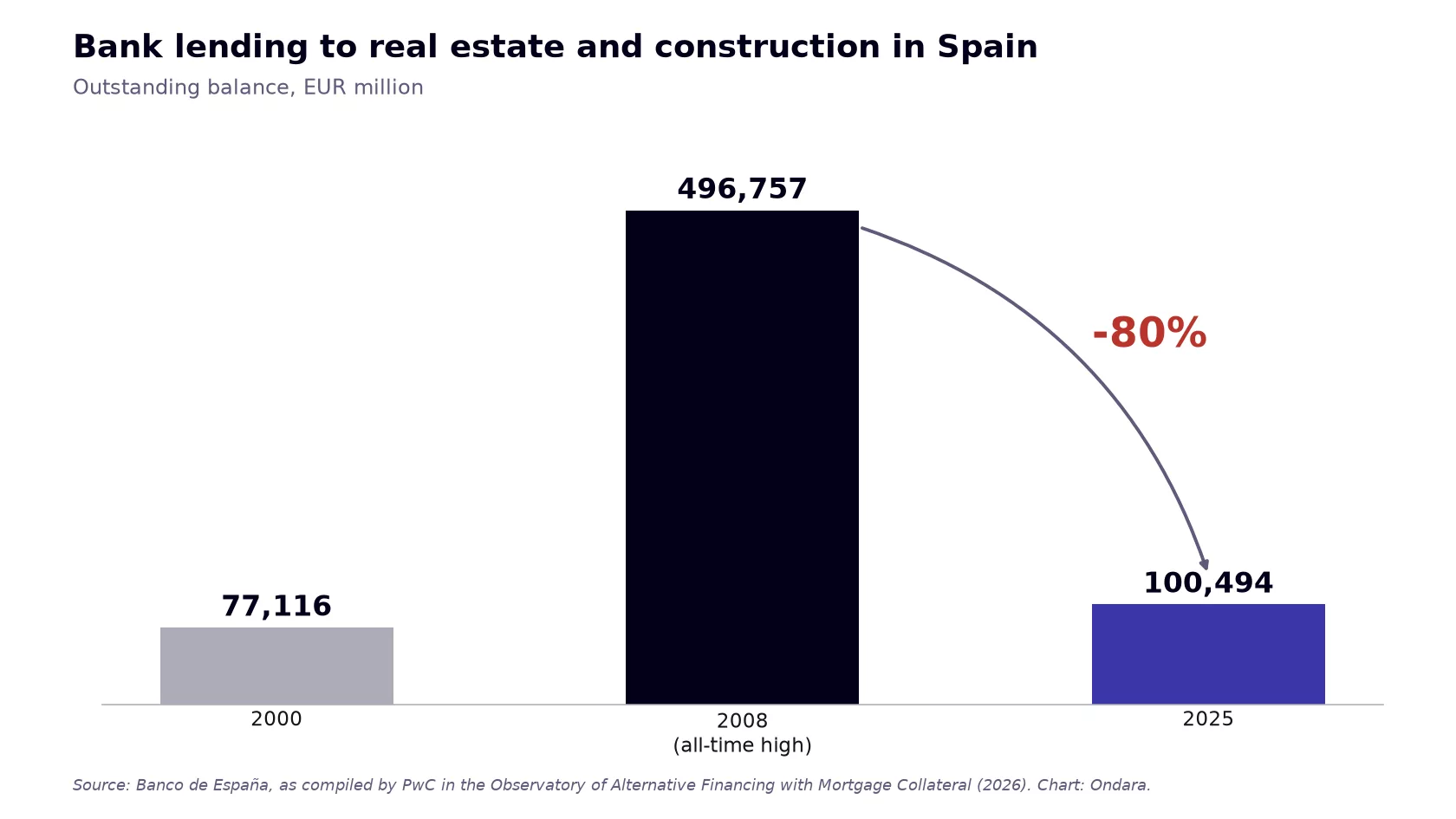
This was not only a reaction to losses. Basel III and the CRR3 Regulation, applicable in the European Union since 1 January 2025, raised the capital a bank must hold for every euro lent to real estate. The result, according to the report, is a banking system that is very efficient in the lowest-risk segment (projects with pre-sales, developers with a track record, income-producing assets) but leaves land acquisition, early-stage phases and projects that do not fit its models uncovered. That gap is where alternative lenders operate, complementing banks rather than competing with them.
The market in numbers: EUR 2,583 million in 2025
Based on a questionnaire answered by 22 lenders and interviews with funds, platforms, banks and developers, the report sizes the market:
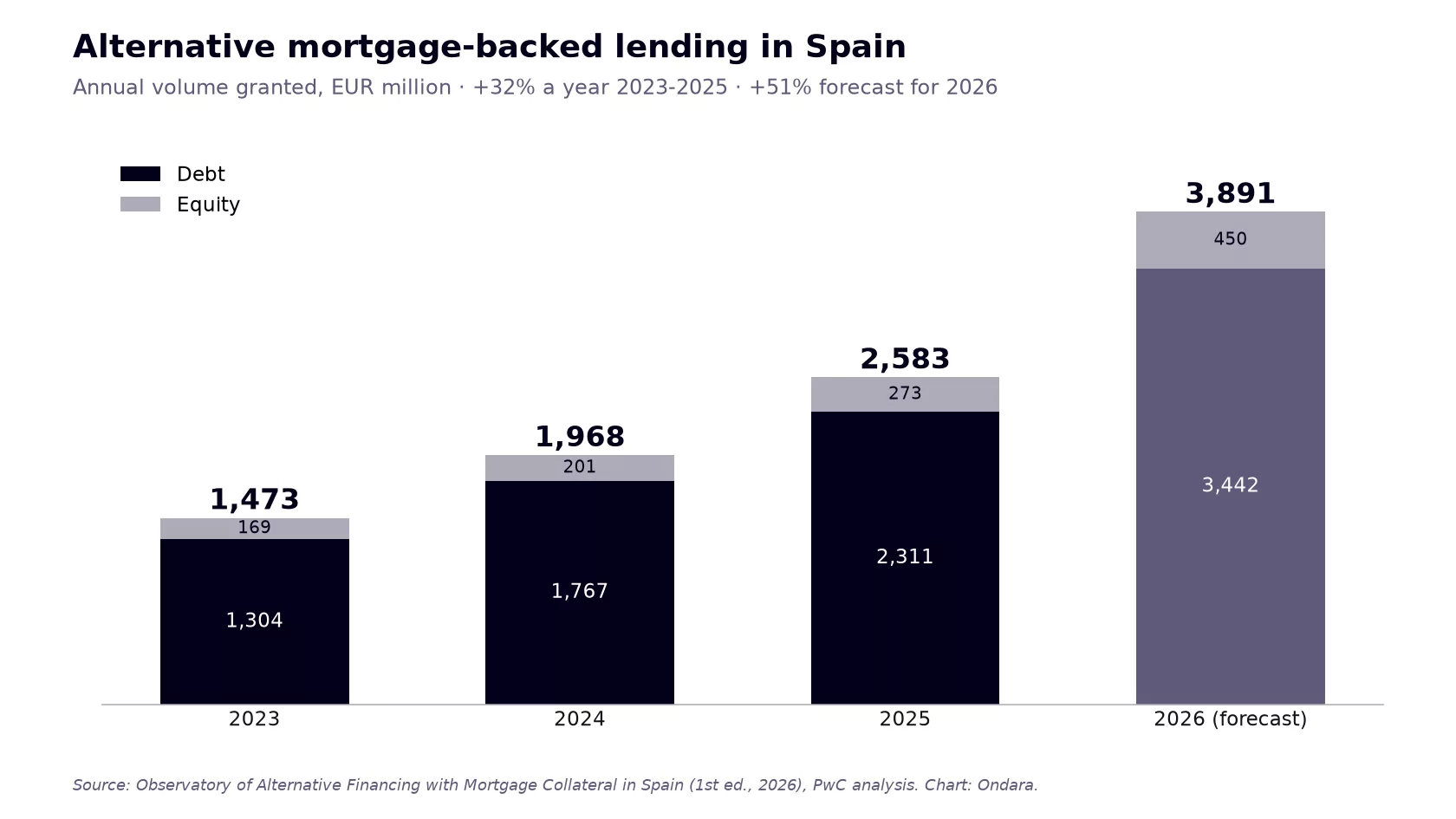
| Indicator | 2023 | 2024 | 2025 | 2026 (forecast) |
|---|---|---|---|---|
| Total volume (EUR m) | 1,473 | 1,968 | 2,583 | 3,891 |
| Debt (EUR m) | 1,304 | 1,767 | 2,311 | 3,442 |
| Equity (EUR m) | 169 | 201 | 273 | 450 |
| Deals closed | 360 | 491 | 594 | 737 |
| Average debt ticket (EUR m) | 4.0 | 3.9 | 4.1 | 4.9 |
Volume grew 32% a year between 2023 and 2025. Debt accounts for around 89% of the total and grows in two ways: more deals (from 329 in 2023 to 557 in 2025) and slightly larger tickets. Equity stays at 31-43 deals a year, but each one is larger: the average equity ticket rose from EUR 4.7 million in 2024 to EUR 7.4 million in 2025.
Who lends and what they finance
In 2025, specialist investment funds provided EUR 2,116 million (82%) and crowdfunding and crowdlending platforms EUR 467 million (18%). Development loans are used by 86% of lenders, bridge loans by 82% and special situations by 64%. By asset type, residential is in the portfolio of 95% of lenders, followed by hotels and logistics (73%) and flex living, student housing and offices (68%).
Real estate crowdfunding has grown too: from EUR 38 million in 2018 to EUR 566 million in 2025, a 47% compound annual rate (Universo Crowdfunding data compiled by PwC).
Average terms of alternative debt
| Term | Average | Reported range |
|---|---|---|
| LTV (loan to value) | 55% | 30%-68% |
| Interest rate | 10% | 7%-20% |
| Duration | 28 months | 11-72 months |
| Ticket per deal | EUR 4.9m | EUR 0.8m-58.3m |
Two takeaways for investors. An average LTV of 55% leaves a value cushion between the debt and the property. And the average 10% rate reflects that this capital takes more risk than banks, which lend at Euribor-linked rates in the safest segments.
Spain compared with other countries: a 20% share
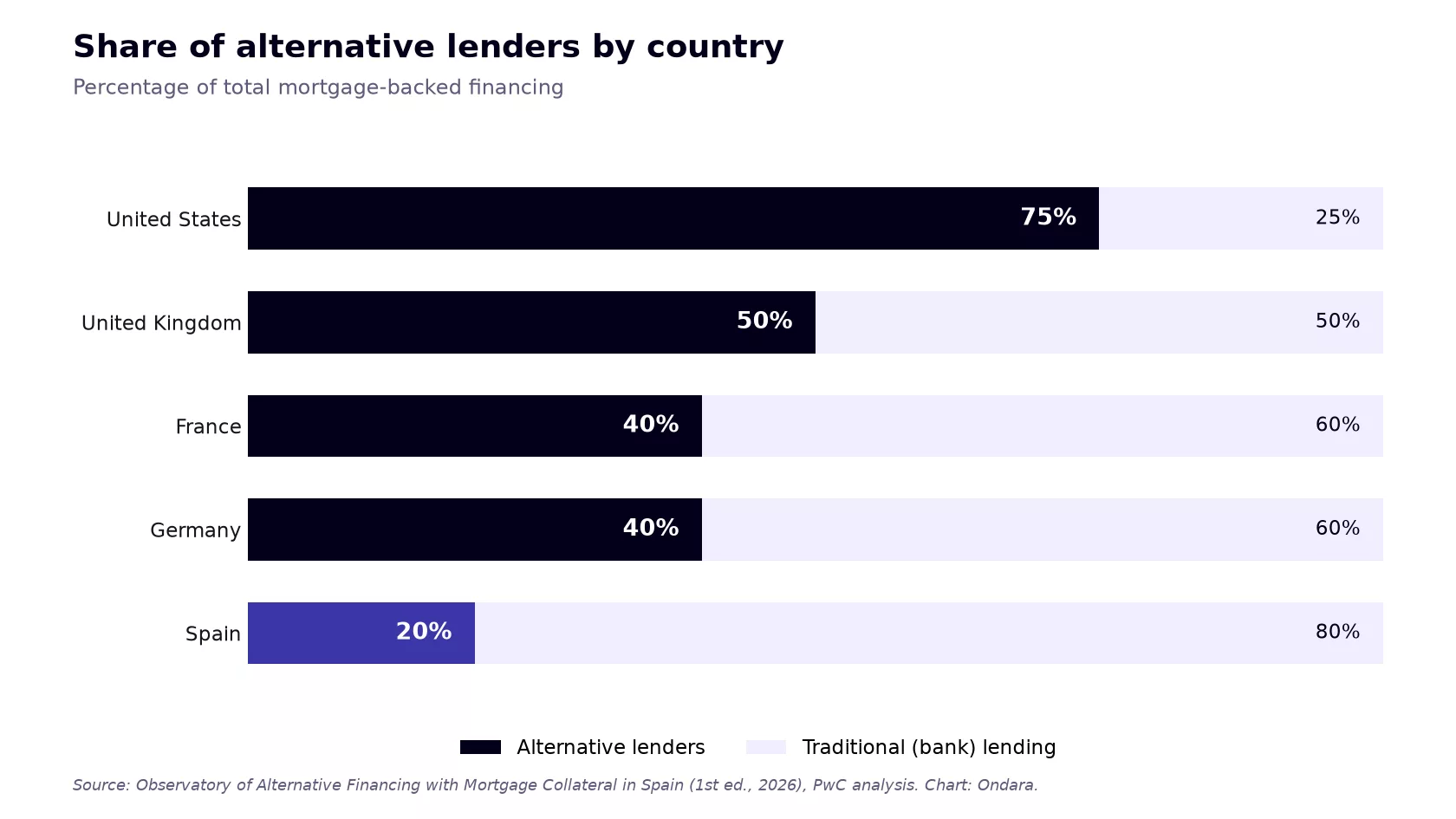
In Spain, alternative lenders account for around 20% of mortgage-backed financing, compared with 75% in the United States, 50% in the United Kingdom and 40% in France and Germany. The report reads this as room to grow: the Spanish market is still heavily bank-based, partly because banks know the development business well and have an incentive of their own, transferring developer loans to end buyers’ mortgages.
What drives demand and supply
PwC identifies five demand drivers:
- Housing shortage: according to projections from Spain’s statistics office (INE), around 238,000 new homes a year will be needed until 2039. The accumulated shortfall since 2008 already stands at 665,000 homes.
- Industrialised construction: industrialised homes delivered rose from 377 in 2019 to 4,272 in 2025 (4.6% of new builds), and banks struggle to accept components built off-site as collateral.
- New asset types (build-to-rent, flex living, student housing, data centres) without enough track record for bank models.
- Deals banks cannot take on because of regulation, such as special situations.
- Greater awareness of the product among mid-sized developers and companies.
On the supply side, there is more capital available (pension funds, insurers and private investors), a gradual fall in the cost of capital, deals closer to bank standards and a fast professionalisation of lenders.
Trends: what is happening worldwide and in Spain
- Worldwide: in the United States and the United Kingdom, non-bank lenders account for over 50% of mortgage-backed financing, according to the report. Direct lending was born there and reached Europe between 2012 and 2014, starting with the UK and France.
- Europe: CRR3, in force since January 2025, increases the capital banks must hold against real estate exposure, which according to the report widens the space for alternative lenders.
- Spain: the presentation of the Observatory in October 2026 (PwC press release, in Spanish) provides the first figures on the volume, deals and terms of this market.
Risks to consider
The report itself points to limits and challenges worth knowing before investing:
- Cost and competition: banks have reacted in the large-developer segment, and alternative lending remains more expensive than bank lending.
- Enforcing collateral: mortgage enforcement in Spain is slow and costly, and stronger debtor protection in deals between professionals would make the market more expensive.
- Regulation: future rules that narrow the gap with banks would limit the sector.
- Lender quality: some operators close deals without proper analysis, a reputational risk if the cycle turns.
- Macroeconomic environment: uncertainty can slow demand and increase defaults.
For investors, there is more: you can lose part or all of your capital, your money is locked in for the term and a deal can take longer than planned. Real estate collateral mitigates risk but does not eliminate it.
Who we are and what we do at Ondara
Ondara Group is a Barcelona-based group working since 2018 in direct lending, real estate and legal services (see our brands). On the map drawn by the report, we operate in the bridge loan segment with mortgage collateral: we lend to companies, property owners and real estate investors who need liquidity at a time when banks cannot help, always secured by a first-ranking mortgage over a property valued by an independent third party.
Members of our investor club choose which deal to join, from EUR 25,000, with terms of 12 to 36 months. We analyse every deal with our finance and legal teams, manage the loan until it is repaid and target double-digit returns, which are never guaranteed. Learn more on who we are or read our article on the bridge-to-term model and its legal keys.
Frequently asked questions
How big is alternative mortgage-backed lending in Spain?
EUR 2,583 million in 2025, across 594 deals. The forecast for 2026 is EUR 3,891 million, according to the Observatory with PwC analysis.
Does it compete with banks?
According to the report, it complements them: it steps into phases and projects that banks cannot finance under their regulatory framework and hands over to them once the project matures.
What are the terms of an average deal?
A 55% LTV, a 10% interest rate, a 28-month term and a EUR 4.9 million ticket, with wide ranges depending on the deal.
Why does Spain have less alternative lending than other countries?
Because of its banking tradition, banks that compete hard for large developers and a certain cultural aversion to debt, according to the report.
Can a private investor take part in this market?
Yes, through crowdfunding platforms or investor clubs such as Ondara’s, from EUR 25,000. It carries the risk of capital loss and illiquidity.
In summary
- The market grew 32% a year between 2023 and 2025 and expects a further 51% in 2026, to EUR 3,891 million.
- It stems from the banks’ retreat: lending to developers has fallen 80% since 2008.
- Debt is almost 90% of volume. Development and bridge loans are the most used instruments.
- Average terms: 55% LTV, 10% interest and a 28-month duration.
- Spain has a 20% share, far from the 40%-75% of other markets.
- All investments carry risk, including capital loss and illiquidity.
If you would like to know how we invest in mortgage-backed loans, register as an investor and we will explain how it works. The minimum investment is EUR 25,000.
This article is for information purposes only and does not constitute an investment recommendation or financial advice. All investments carry risks, including the possible loss of the capital invested, and past or target returns do not guarantee future returns. Analyse each opportunity with a professional before investing.